
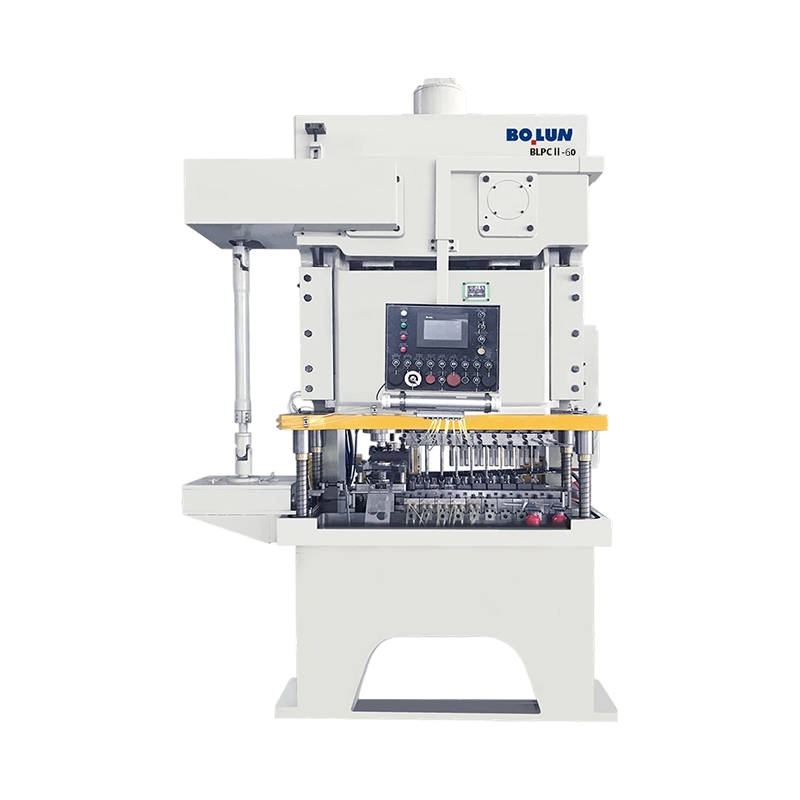


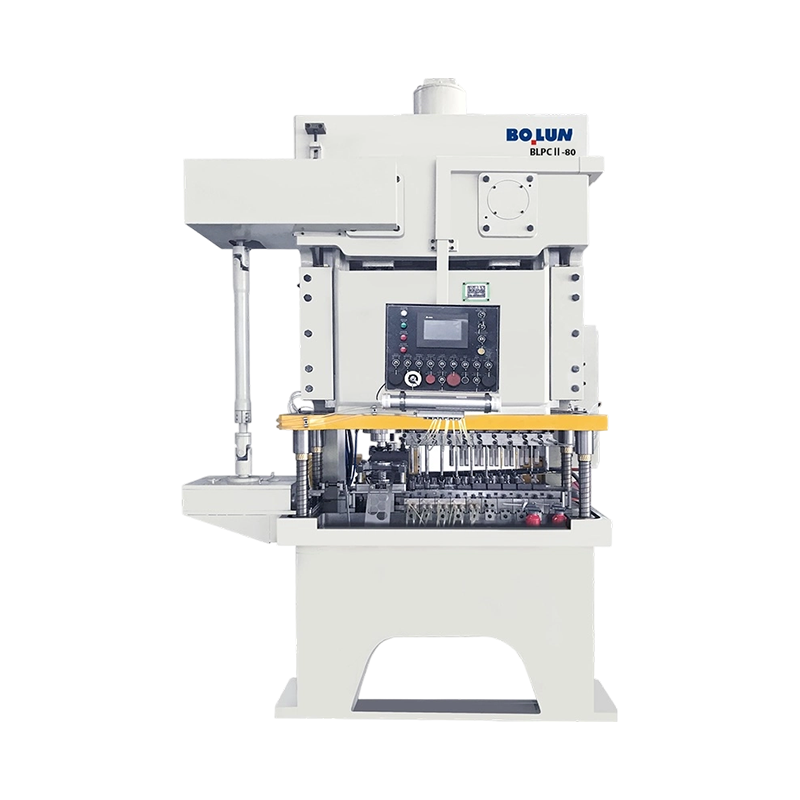
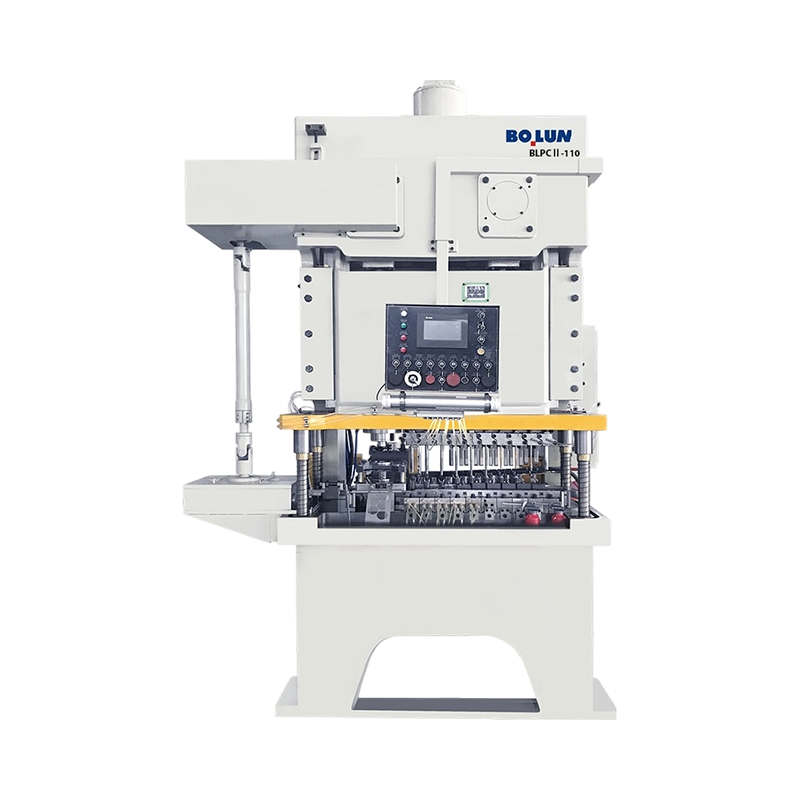
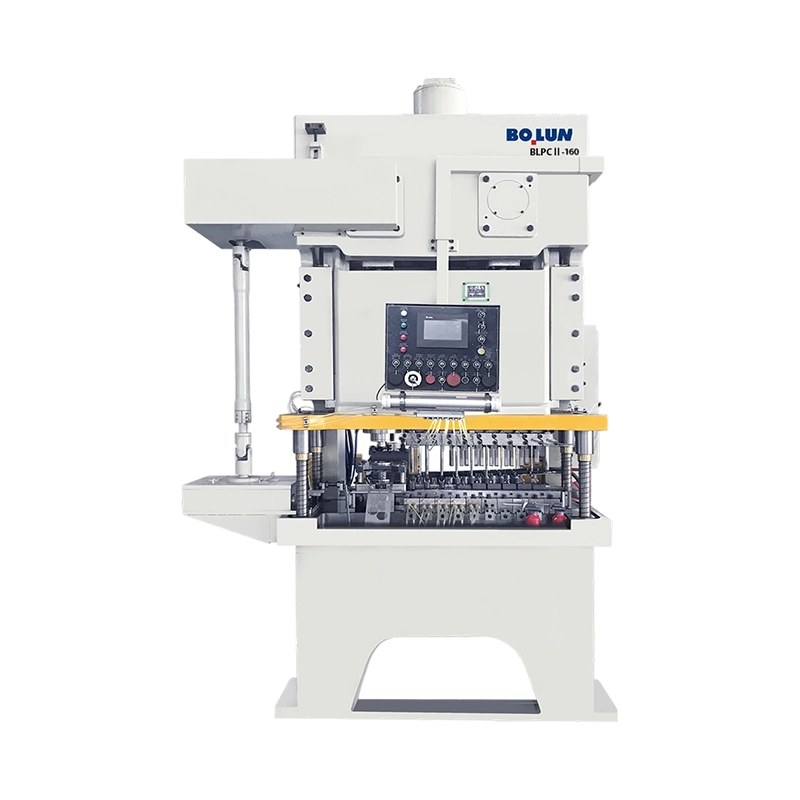
The Bolun Open-Type Double-Point Battery Power Press is a specialized high-performance solution engineered specifically for the rapidly evolving battery manufacturing sector. As the global demand for electric vehicles (EVs) and energy storage systems surges, our battery press provides the extreme precision and stability required to produce critical components like battery casings, cell lids, and lead-acid grids with unmatched repeatability.
Dual-Point Drive for Wide-Sheet Stability
The defining advantage of this series is its double-crankshaft drive mechanism. Battery components often require wide, multi-station progressive dies. By distributing force across two synchronized points, the double-point system offers superior resistance to eccentric (off-center) loading. This ensures the slide remains perfectly parallel to the bolster throughout the stroke, preventing the slight tilting that can lead to uneven thickness or edge defects in sensitive battery materials.
Optimized for Thin-Material Precision
Stamping thin aluminum or steel sheets for battery cells demands zero margin for error. Our press features a reinforced steel-plate welded frame and high-precision, multi-face guide rails that maintain rigid alignment even during high-frequency cycles. This structural integrity minimizes vibration and "spring-back," extending the life of high-cost carbide dies and ensuring every component meets the strict dimensional tolerances required for automated battery assembly.
Engineering Durability and Performance
In line with Bolun’s premium standards, the internal transmission relies on forged 42CrMo alloy steel crankshafts and CuSn12 tin bronze bushings. The integration of a high-torque pneumatic friction clutch and a hydraulic overload protector ensures that the machine can handle continuous 3-shift production with minimal maintenance.
Smart Factory Integration
Fully optimized for the modern "Gigafactory," the press features a PLC-based smart control system. It offers seamless synchronization with high-speed NC servo feeders and robotic transfer arms. With its combination of a large workspace, anti-tilting technology, and digital integration, the Bolun Battery Power Press is the ultimate cornerstone for high-volume, high-quality battery production.
Bolun Machinery: Powering the Future of Energy Storage with Precision.
As China Open-Type Double-Point Battery Power Press Manufacturers and Open-Type Double-Point Battery Power Press Suppliers, Zhejiang Bolun High-Precision Machinery Co., Ltd. is located in Zhejiang, the heart of China’s precision manufacturing. With two decades of deep roots in the machinery manufacturing industry, the company has leveraged profound industry accumulation and technical breakthroughs to evolve into a modern, leading enterprise in high-precision forming equipment. We integrate R&D, design, production, sales, and service. From our early days of persevering through challenges to our current leadership in the fields of forging and casting machinery, Bolun Machinery has established a professional, mature, and efficient production management system. We are dedicated to providing global customers with superior industrial machine tool solutions.
 More About Us
BOLUN
More About Us
BOLUN

0+
years
Industry Experience

0+
Units Produced (Previous Year)

0+
Number of Employees

0+
$
Million Annual Output Value

Put a 160-ton open-frame press and a 160-ton closed-frame press side by side and the difference is visible from thirty feet away. One leaves the die area open on three sides so an operator can slide a wide blank in by hand; the other wraps the same die inside a box of stress-relieved steel that barely flexes at full l...
Start With the Purchase Decision, Not the Definitions A procurement engineer comparing a 200-ton hydraulic press quote with a 200-ton mechanical power press quote often finds two different machines, two different cost structures, and two different production promises, even when the tonnage number is identical. That ha...
A tooling engineer quotes a new bracket program and specifies a 160-ton press. The die is built, the machine is installed, and on the first production run the slide stalls six millimetres above bottom dead centre. Nothing is broken. The tonnage was rated at the bottom of the stroke, and the work is being done higher u...
The high-volume production of lithium-ion battery cases, cover plates, and internal terminals demands high speed and repeating accuracy. Stamping battery components often utilizes thin-gauge aluminum or copper foil materials that are highly sensitive to material misfeeds, wrinkles, and tool misalignment. During these rapid operations, even a minor displacement of the strip material can cause severe tooling damage or initiate safety hazards if friction causes temperature spikes near sensitive areas. Therefore, an open-type double-point battery power press must be integrated with a fast safety protection system that can detect anomalies and halt slide motion within fractions of a second. These safety systems protect the delicate multi-station progressive dies, which require considerable time and investment to manufacture and calibrate. Safeguarding the operational staff and the mechanical components requires a deep integration of fast sensors and reliable stopping mechanisms.
Because battery components are stamped in continuous runs, any interruption must be managed with minimal mechanical stress. If the emergency stop is too slow, the punch can crash into a misaligned strip, resulting in fractured die elements and long production delays. Conversely, if the braking action is too sudden or uncoordinated, it can transfer heavy shock loads through the drive train, leading to premature wear of the bearings. Striking a balance between deceleration speed and structural load management is a key focus in modern high-speed metal forming applications.
To achieve the necessary deceleration speeds, the safety system relies on a continuous electronic monitoring loop. Modern stamping setups utilize dual-channel safety light curtains and optoelectronic sensors positioned around the working space of the open-type double-point battery power press. When an object or an out-of-position metal strip interrupts the light beam, the sensor generates an output signal within a few milliseconds. This signal is processed by a dedicated safety PLC that utilizes redundant logic to verify the error state, preventing false trips while ensuring that genuine safety hazards are acted upon immediately. The electronic processing delay in these setups is kept low, typically under ten milliseconds, before the electrical command is issued to shut off the power to the main safety valves.
The redundancy of the dual-channel system ensures that even if one sensor channel fails, the secondary channel can complete the safety cycle. This electronic setup is paired with real-time diagnostic software that monitors the status of the inputs and outputs. Zhejiang Bolun High-Precision Machinery Co., Ltd. designs these integrated control networks to prioritize safe state transitions, ensuring that any sensor interruption initiates an immediate, coordinated shutdown of the press drive train, preserving both operator safety and tooling alignment.
Once the safety controller processes the emergency stop command, the mechanical phase of the shutdown begins. The open-type double-point battery power press utilizes a combined pneumatic clutch-brake unit to control slide travel. Upon receiving the electrical cut-off signal, the dual-channel safety solenoid valve exhausts the pressurized air from the clutch chamber. This rapid drop in pressure allows heavy-duty mechanical springs to push the brake shoes against the brake drum, generating the friction torque required to stop the rotating eccentric shaft. Because a double-point slide has a wider bolster area and supports heavier tool sets, the inertial forces are larger than those found in single-point presses. The braking system must therefore be sized with a larger friction surface area to absorb this kinetic energy without experiencing thermal fade.
The physical coordination between the clutch releasing and the brake engaging must occur in a precise sequence to prevent overlapping friction wear while keeping the total stopping time well within standard limits. A typical combined clutch-brake design prevents simultaneous engagement by utilizing a single piston shaft, which mechanically ensures that the clutch is fully disengaged before the brake pads contact the drum. This layout minimizes the heat generated during emergency stops, protecting the friction materials and maintaining a consistent stopping time over thousands of operational cycles.
The exact stopping performance of the machine is a combination of electrical reaction time, valve exhaust speed, and mechanical friction deceleration. The table below outlines the typical performance boundaries observed under different operating speeds and tool weights on these double-point platforms.
| Stamping Speed (SPM) | Tooling Weight (kg) | Electrical Reaction Time (ms) | Mechanical Braking Time (ms) | Total Safety Response Time (ms) | Slide Travel Distance (mm) |
|---|---|---|---|---|---|
| 60 SPM | 800 | 8 to 12 | 90 to 110 | 98 to 122 | 12 to 15 |
| 100 SPM | 800 | 8 to 12 | 105 to 130 | 113 to 142 | 22 to 28 |
| 150 SPM | 500 (Lightweight) | 8 to 12 | 115 to 145 | 123 to 157 | 35 to 42 |
| 200 SPM | 500 (Lightweight) | 8 to 12 | 130 to 165 | 138 to 177 | 50 to 60 |
As the data indicates, higher operating speeds increase the total stopping time due to the relationship between velocity and kinetic energy. The mechanical braking time represents the largest portion of the safety response cycle, highlighting the importance of optimizing the air exhaust path. Using larger air lines and quick-exhaust valves located close to the clutch-brake housing allows the air pressure to escape almost instantly, which directly decreases the stopping distance. Maintaining these rapid stopping times prevents the punch from traveling deep into a misaligned die, which would otherwise cause component breakage.
Safety stopping times are only effective if the physical structure of the press can withstand the sudden deceleration forces. During an emergency stop, the sudden application of the brake transfers a large torsional reaction force into the frame weldments. An open-type double-point battery power press features a C-frame design that must be reinforced to prevent structural twisting under these dynamic loads. Bolun Machinery manufactures these press frames using thick, high-tensile steel plates that are thoroughly welded and stress-relieved to create a robust structure. This rigidity ensures that the guide gibs remain parallel, preventing the slide from tilting or binding during a sudden stopping sequence.
Additionally, integrating high-speed hydraulic overload protection systems inside the slide provides an extra layer of protection. This system releases hydraulic pressure within milliseconds if the forming force exceeds the preset limit, working in tandem with the electronic safety systems to preserve equipment integrity. By combining electronic safety monitoring, optimized pneumatic valves, and a rigid, stress-relieved frame structure, modern presses achieve the fast response times required to run high-speed battery component stamping lines with consistent safety and reliability.
Q: What specific features prevent material misfeeds and tooling crashes during high-speed production on an open-type double-point battery power press?
A: Our press is integrated with a dual-channel electronic safety monitoring loop and high-speed response sensors that communicate directly with a safety PLC. In the event of a material misfeed or alignment variance, the system triggers the pneumatic clutch-brake unit to exhaust instantly, bringing the slide to a complete stop within milliseconds to protect delicate multi-station progressive dies.
Q: How does the double-point design of this battery press handle the wide progressive dies commonly used for battery cases and cover plates?
A: The open-type double-point battery power press distributes the stamping force across two synchronized connection points on the slide. This layout provides exceptional resistance to off-center loading, maintaining precise slide parallelism and ensuring uniform pressure distribution across wide, complex tooling sets.
Q: Does Zhejiang Bolun High-Precision Machinery Co., Ltd. offer custom bolster and stroke adjustments to fit specialized battery component manufacturing?
A: Yes, we utilize our established R&D and design capabilities to customize the press dimensions, stroke lengths, and slide-bolster area clearances. This allows us to tailor the machinery to the exact mechanical requirements of your proprietary battery cell housings, tabs, or safety vent designs.
Q: What structural measures are integrated to handle the extreme deceleration torque during emergency stops?
A: During a sudden brake engagement, significant rotational forces are transferred into the frame. Bolun Machinery manufactures these press structures using thick, pre-stressed steel plates that undergo rigorous stress-relieving processes. This high torsional rigidity prevents frame twisting and keeps the slide guides perfectly aligned during rapid safety stops.
Q: How does the press control system manage the narrow blank holder force margins required for thin copper or aluminum battery foils?
A: The press can be equipped with dynamic pneumatic balancer systems and precise hydraulic cushion controls. This combination allows for minute adjustments to the clamping and counter-tensioning forces, preventing the thin-gauge metal foils from wrinkling or tearing during the rapid drawing stages.
Contact Us

+86-575-83362228

+86-13735238388

+86-575-83362999

+86-15158259588

Hangzhou Office Add: No. 332 Wangjiang East Road, Shangcheng District

No.1 Linjiang Road East, Xiaren, Jinting Town, Shengzhou City, Zhejiang Province, China
Ready to Begin?
Get in Touch

Now!

ZHEJIANG BOLUN
 English
 中文简体
中文简体