
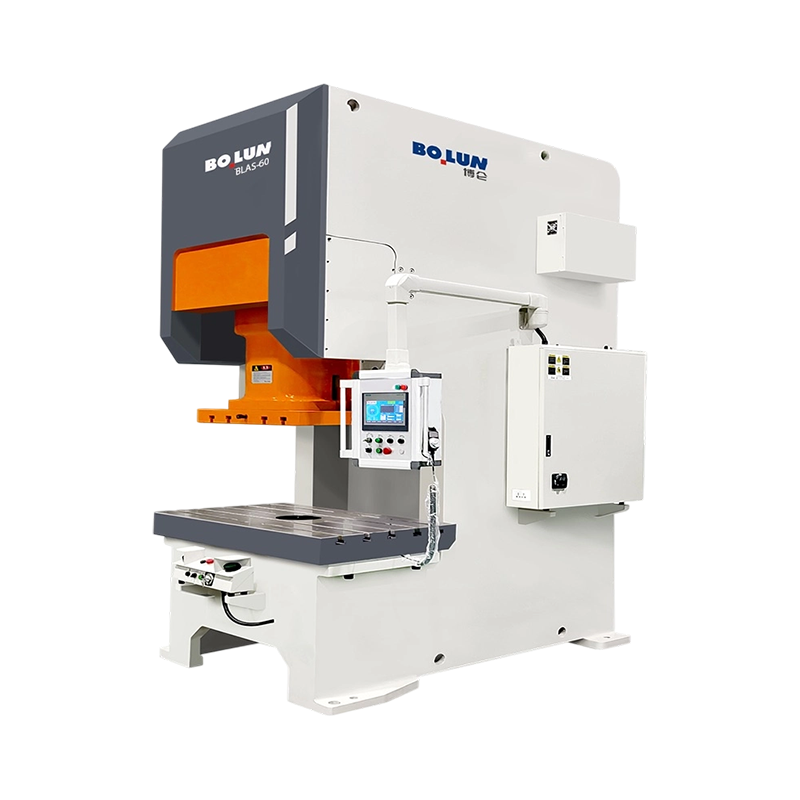


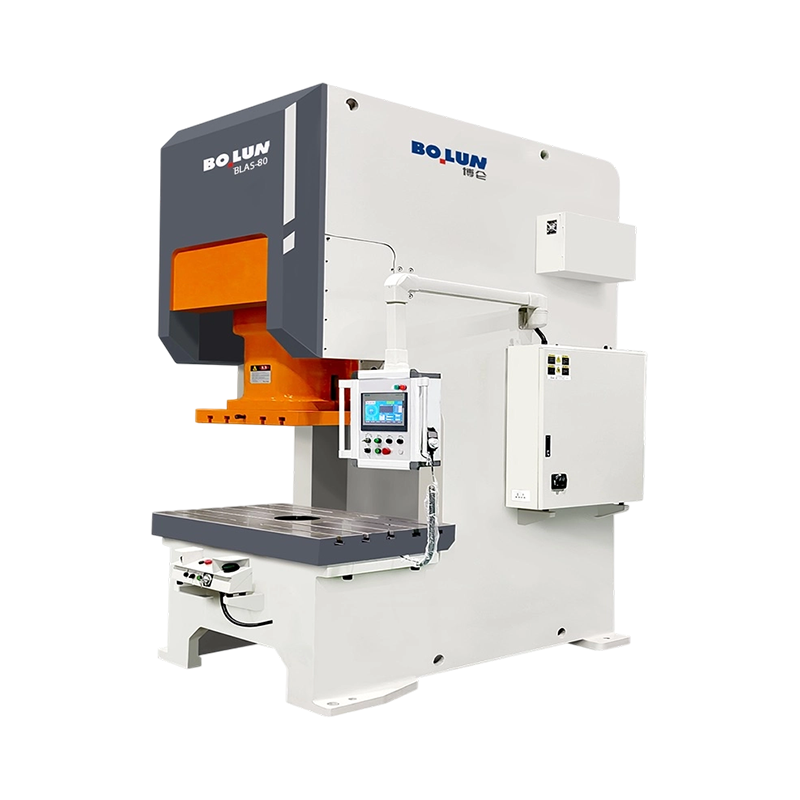
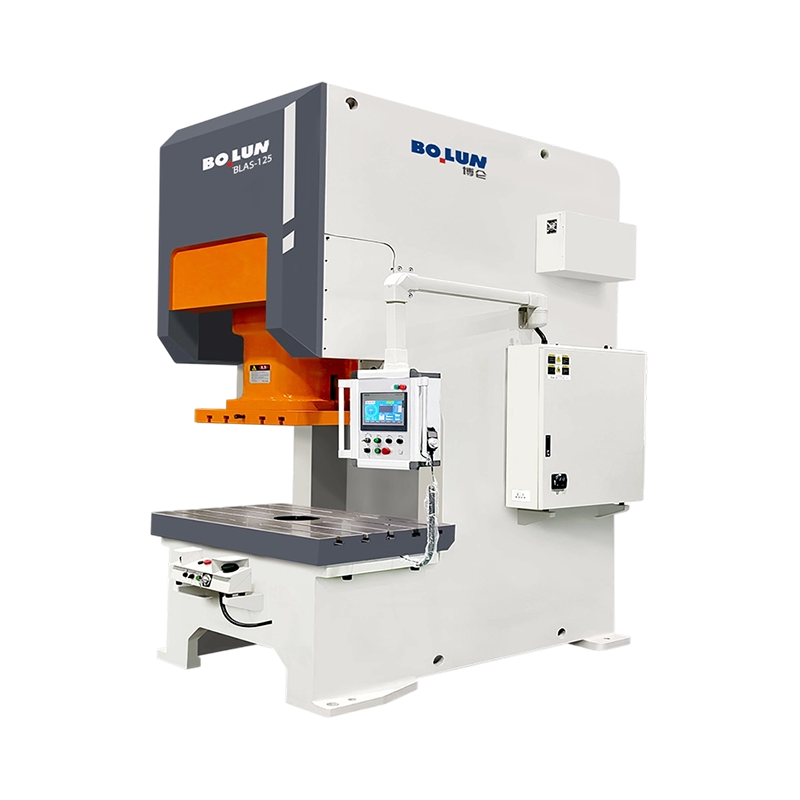
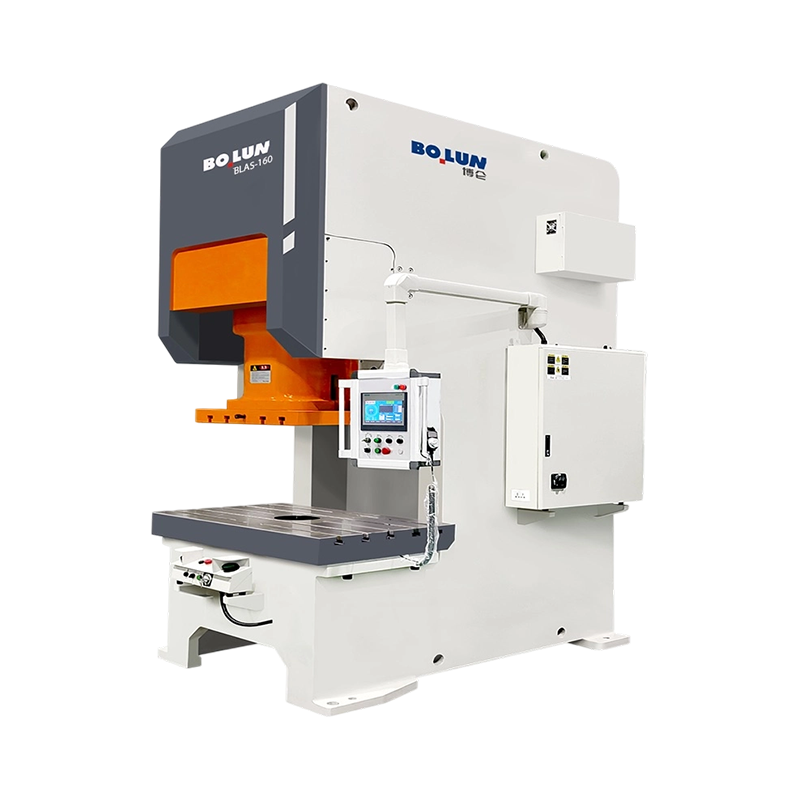
The Bolun Open-Type Single-Point Servo Power Press represents a revolutionary leap in metal forming technology, combining the structural reliability of a classic C-frame with the limitless flexibility of modern servo-drive systems. Unlike traditional mechanical presses that rely on flywheels and clutches, our servo series utilizes a high-torque, dedicated servo motor to drive the slide directly, offering unparalleled control over the stamping process.
Programmable Motion Profiles for Maximum Versatility
The defining advantage of the Bolun Servo Press is its ability to customize slide motion. Users can program the stroke with specific curves—such as pendulum, link-motion, constant velocity, or pulse—to suit different materials and complex part geometries. This flexibility allows for optimized metal flow, significant reduction in material spring-back, and superior surface finishes, making it ideal for high-precision electronics, automotive sensors, and aerospace components.
Enhanced Productivity and Tool Longevity
By utilizing a "soft-touch" approach during the forming phase and a rapid return stroke, the Bolun Servo Press minimizes impact noise and vibration. This gentle interaction significantly reduces shock loads on expensive tooling, extending die life by up to 300% compared to traditional presses. Furthermore, the absence of a pneumatic clutch reduces maintenance downtime and eliminates the energy loss associated with compressed air systems.
Energy Efficiency and Sustainable Manufacturing
Equipped with an advanced energy management system, our servo presses consume 30% to 50% less electricity than conventional mechanical presses. The system captures energy during deceleration and recycles it for the next stroke, providing a greener solution for the modern "Eco-Factory."
Rigid Construction and Smart Integration
Despite its advanced electronics, the machine maintains Bolun’s signature structural integrity with a high-tensile, stress-relieved steel frame. Integrated with a PLC-based smart control system and a high-resolution HMI, the press supports seamless "handshaking" with NC feeders and robotic transfer systems, making it the perfect cornerstone for any fully automated smart manufacturing line.
Bolun Servo Technology: Precision in Motion, Excellence in Every Stroke.
As China Open-Type Single-Point Servo Power Press Manufacturers and Open-Type Single-Point Servo Power Press Suppliers, Zhejiang Bolun High-Precision Machinery Co., Ltd. is located in Zhejiang, the heart of China’s precision manufacturing. With two decades of deep roots in the machinery manufacturing industry, the company has leveraged profound industry accumulation and technical breakthroughs to evolve into a modern, leading enterprise in high-precision forming equipment. We integrate R&D, design, production, sales, and service. From our early days of persevering through challenges to our current leadership in the fields of forging and casting machinery, Bolun Machinery has established a professional, mature, and efficient production management system. We are dedicated to providing global customers with superior industrial machine tool solutions.
 More About Us
BOLUN
More About Us
BOLUN

0+
years
Industry Experience

0+
Units Produced (Previous Year)

0+
Number of Employees

0+
$
Million Annual Output Value

Put a 160-ton open-frame press and a 160-ton closed-frame press side by side and the difference is visible from thirty feet away. One leaves the die area open on three sides so an operator can slide a wide blank in by hand; the other wraps the same die inside a box of stress-relieved steel that barely flexes at full l...
Start With the Purchase Decision, Not the Definitions A procurement engineer comparing a 200-ton hydraulic press quote with a 200-ton mechanical power press quote often finds two different machines, two different cost structures, and two different production promises, even when the tonnage number is identical. That ha...
A tooling engineer quotes a new bracket program and specifies a 160-ton press. The die is built, the machine is installed, and on the first production run the slide stalls six millimetres above bottom dead centre. Nothing is broken. The tonnage was rated at the bottom of the stroke, and the work is being done higher u...
Traditional mechanical presses utilize a fixed flywheel and crankshaft to drive the slide in a predetermined harmonic motion. This mechanical limitation means the speed and stroke length of the slide are constant for any given cycle, offering no flexibility to adjust to varying material requirements. In contrast, an open-type single-point servo power press replaces the traditional flywheel and clutch system with a high-torque, low-speed servo motor coupled directly to the drive mechanism. This direct control allows the operator to program the rotation of the main shaft in real-time, effectively customizing the speed, position, and acceleration of the slide at any point during its downward and upward travel. This advancement enables manufacturers to adapt a single piece of machinery to a wide array of forming processes, ranging from high-speed blanking to deep drawing of complex profiles.
By removing the physical constraints of the classic flywheel, the press can execute customized deceleration and acceleration curves that match the precise deformation limits of the workpiece. This capability is useful when working with modern materials like advanced high-strength steels and lightweight aluminum alloys, which are prone to springback and tearing under conventional stamping speeds. The transition to servo technology represents a fundamental shift in how kinetic energy is managed in the stamping shop, giving operators control over the stroke profile while maintaining the structural accessibility of the C-frame design.
Within the programming suite of the open-type single-point servo power press, the crankshaft simulation mode reproduces the classic sinusoidal movement profile of conventional mechanical machinery. This mode is useful for standard stamping, progressive die applications, and high-volume production where specialized velocity curves are not required. By rotating the drive motor at a constant speed through a full 360-degree rotation, the slide reaches its maximum velocity at the midpoint of the stroke and slows to zero at bottom dead center. This replication ensures compatibility with existing tooling that was designed for traditional mechanical presses, providing a familiar baseline for daily shop operations.
Additionally, the controller can simulate link motion profiles without requiring complex physical lever mechanisms. In conventional presses, link motion is achieved through a network of physical rods that slow down the slide near the bottom of the stroke while accelerating it during the upward recovery phase. The servo drive achieves this velocity modification purely through electronic speed adjustments during a single cycle. Zhejiang Bolun High-Precision Machinery Co., Ltd. builds control interfaces that allow operators to configure the exact decelerating curve required to match the drawing threshold of specific sheet metals, reducing the mechanical complexity and maintenance requirements associated with dedicated link-drive machinery.
The pendulum motion mode, also known as the swing or half-stroke mode, is a unique operational profile that does not require the drive motor to complete a full rotation. Instead, the servo motor rotates the eccentric shaft forward to a specified angle, drives the slide through its working stroke, and then reverses direction to return the slide to the top starting position. Because the motor only swings through a limited arc, the overall stroke travel is shortened, which reduces cycle times and increases production speed for shallow forming or blanking operations. This mode is highly beneficial when processing continuous strip materials where full vertical clearance is unnecessary, allowing for high stroke rates while saving energy.
For progressive or multi-stage forming of difficult-to-form metals, the pulsing or incremental step mode is utilized. In this configuration, the open-type single-point servo power press does not press the metal in a single continuous movement. Instead, the slide descends in a series of micro-strokes, applying force incrementally. This step-by-step deformation allows internal material stresses to distribute more evenly, reducing localized thinning and avoiding fracture lines in high-strength alloys. Each pulse can be programmed with distinct dwell periods, letting the metal rest and stabilize between press segments to achieve a more uniform material flow.
In deep drawing and cold forging, controlling the metal flow at the bottom dead center is critical to maintaining uniform wall thickness and minimizing springback. The bottom dwell mode allows the slide to come to a complete stop at the bottom of the stroke for a specified duration while maintaining full tonnage pressure. This pause gives the material sufficient time to undergo plastic deformation and take the shape of the die cavity permanently. Once the dwell period expires, the servo motor restarts to return the slide to its starting position, resulting in parts with consistent dimensional accuracy and minimal residual stress.
The constant velocity drawing mode adjusts the slide speed dynamically during the critical forming phase. Standard crank drives cause the slide to accelerate continuously until the midpoint, which can exceed the drawing speed limits of sensitive materials like aluminum or titanium. The servo press controls the motor rotation to ensure the slide maintains a flat, constant speed curve through the entire draw depth. Once the forming stage is complete, the slide accelerates rapidly on the return stroke, optimizing productivity without risking material tears or wrinkles. This control allows manufacturers to run delicate parts successfully on a standard production line.
The following table provides a comparison of the primary motion profiles available on modern servo-driven single-point presses, detailing their typical parameters and primary application areas.
| Motion Profile | Motor Rotation Type | Speed Characteristics | Primary Forming Application | Typical Cycle Efficiency |
|---|---|---|---|---|
| Crank Simulation | Full 360-degree rotation | Sinusoidal curve | Standard blanking and progressive stamping | Baseline standard |
| Link Simulation | Full 360-degree rotation | Slow draw speed, rapid return | General deep drawing and bending | High due to reduced scrap |
| Pendulum Mode | Partial oscillating swing | Variable speed based on stroke angle | Shallow drawing, high-speed blanking | Highest for short-stroke parts |
| Pulsing Mode | Incremental step rotation | Micro-strokes with rapid pauses | Thick plate forming and difficult-to-draw alloys | Moderate, prioritized for quality |
| Bottom Dwell | Full rotation with paused interval | Stops at bottom dead center under load | Springback prevention and precise coining | Adjustable based on dwell duration |
To execute these complex motion profiles repeatedly, the physical construction of the open-type single-point servo power press must handle varied mechanical and thermal conditions. Reversing the heavy servo motor and slide components during pendulum or pulse operations generates substantial heat and dynamic torque fluctuations. Robust frame engineering and cooling circuits are necessary to stabilize the motor and drive temperatures. Additionally, precise linear guide gibs are integrated to ensure slide verticality is preserved even when the motor undergoes rapid direction changes under full load.
Bolun Machinery applies structural design principles and precision components to ensure that the slide remains parallel under these dynamic operating modes, protecting both the drive mechanism and the tooling from premature wear. A continuous forced lubrication system maintains a consistent oil film across all sliding surfaces, absorbing the shock forces associated with pulsing operations. This combination of thermal management, structural stiffness, and programmable servo control ensures that the machinery remains a stable and reliable platform for diverse industrial stamping demands over long service lifetimes.
Q: How does the programmable slide motion of an open-type single-point servo power press help minimize springback in high-strength materials?
A: By replacing the traditional flywheel with a high-torque servo motor, the slide motion can be fully customized. Zhejiang Bolun High-Precision Machinery Co., Ltd. programs these presses to execute a bottom dwell or slow-down profile near the bottom dead center, allowing the material sufficient time to undergo plastic deformation and permanently set its shape.
Q: What measures are in place on Bolun Machinery servo presses to handle the extreme heat and torque fluctuations of rapid pendulum or pulsing modes?
A: Operating in pendulum or pulsing modes requires rapid motor deceleration and direction changes, which generate substantial thermal and mechanical stress. Our open-type single-point servo power press designs incorporate dedicated liquid-cooling circuits for the servo drive and an automatic, high-pressure forced lubrication system to dissipate heat and protect the main shaft bearings.
Q: Can the slide stroke length and speed be optimized for shallow stamping parts to increase hourly output?
A: Yes, using the pendulum motion mode, the servo motor only swings through a programmed partial angle rather than completing a full 360-degree rotation. This shortens the stroke path and decreases cycle times, allowing manufacturers to achieve high production rates for shallow parts while saving energy compared to full-stroke operations.
Q: How do your servo power presses maintain slide parallelism during asymmetrical, off-center loading cycles?
A: Despite having only a single connection point, the slide is guided by extended, precision-machined eight-point gibs with exceptionally tight clearances. This heavy-duty guiding configuration works alongside our rigid, stress-relieved C-frame to absorb lateral forces and prevent slide tilting throughout the forming stroke.
Q: Does Zhejiang Bolun High-Precision Machinery Co., Ltd. offer custom-developed software profiles for unique, proprietary forming processes?
A: We provide full R&D, design, and software customization services. Our engineering team can develop and integrate tailored motion profiles, including constant-velocity draw curves or multi-step incremental pulsing cycles, directly into the press control system to meet your exact material and tooling specifications.
Contact Us

+86-575-83362228

+86-13735238388

+86-575-83362999

+86-15158259588

Hangzhou Office Add: No. 332 Wangjiang East Road, Shangcheng District

No.1 Linjiang Road East, Xiaren, Jinting Town, Shengzhou City, Zhejiang Province, China
Ready to Begin?
Get in Touch

Now!

ZHEJIANG BOLUN
 English
 中文简体
中文简体