
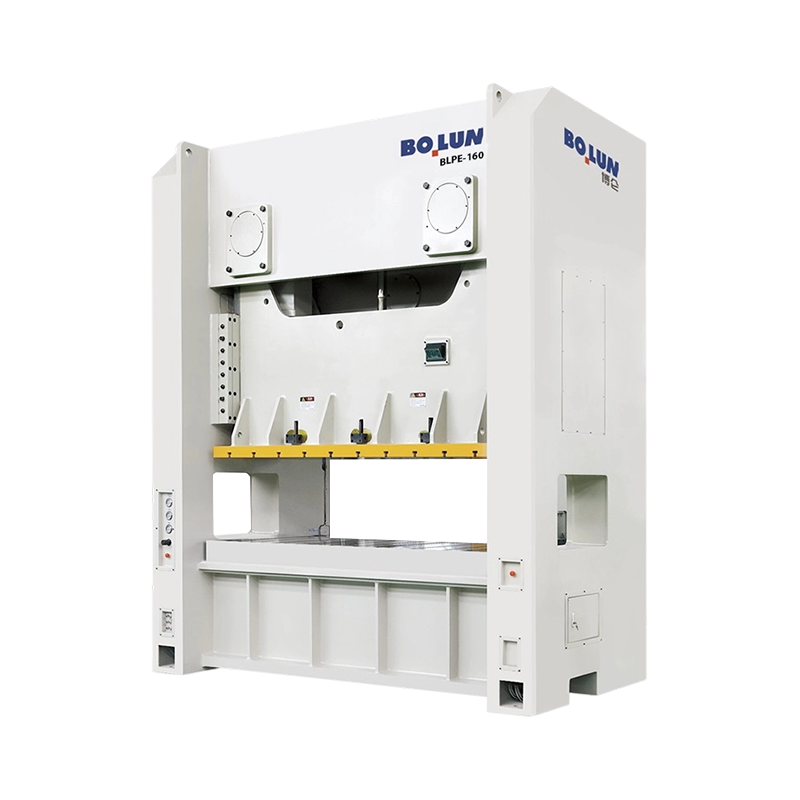


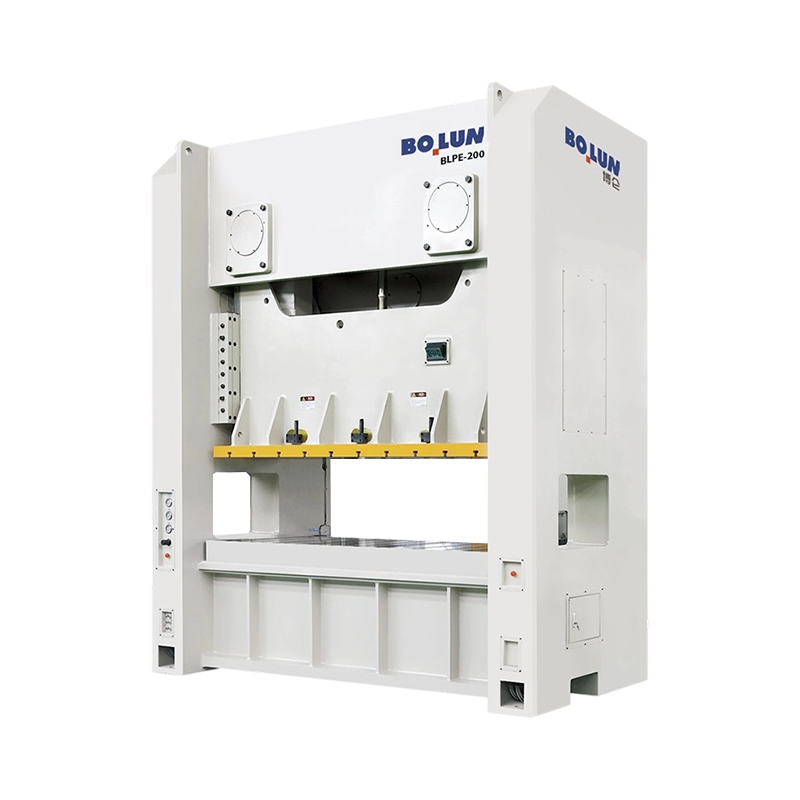
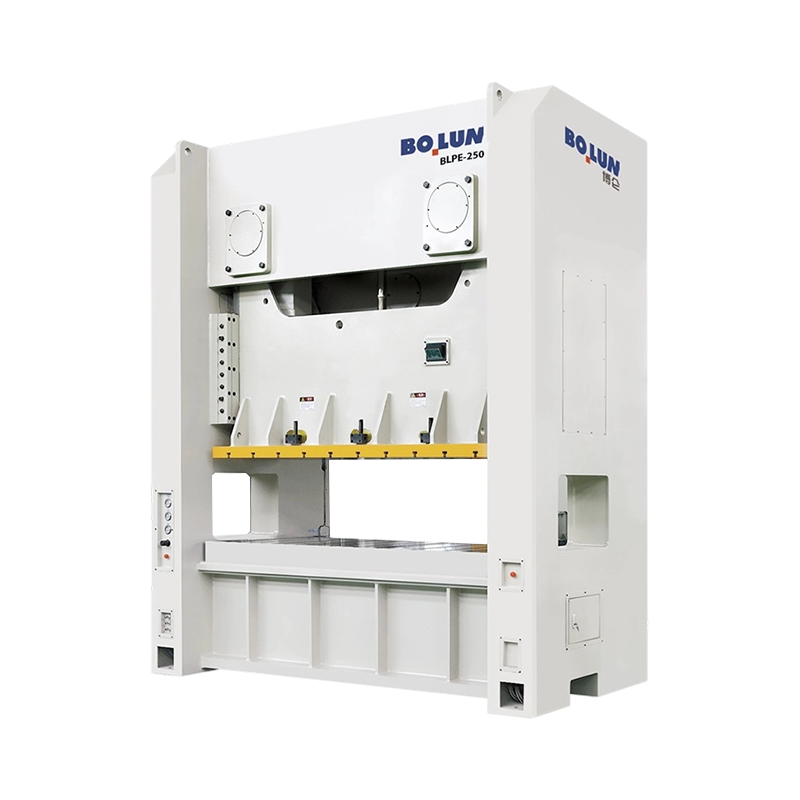
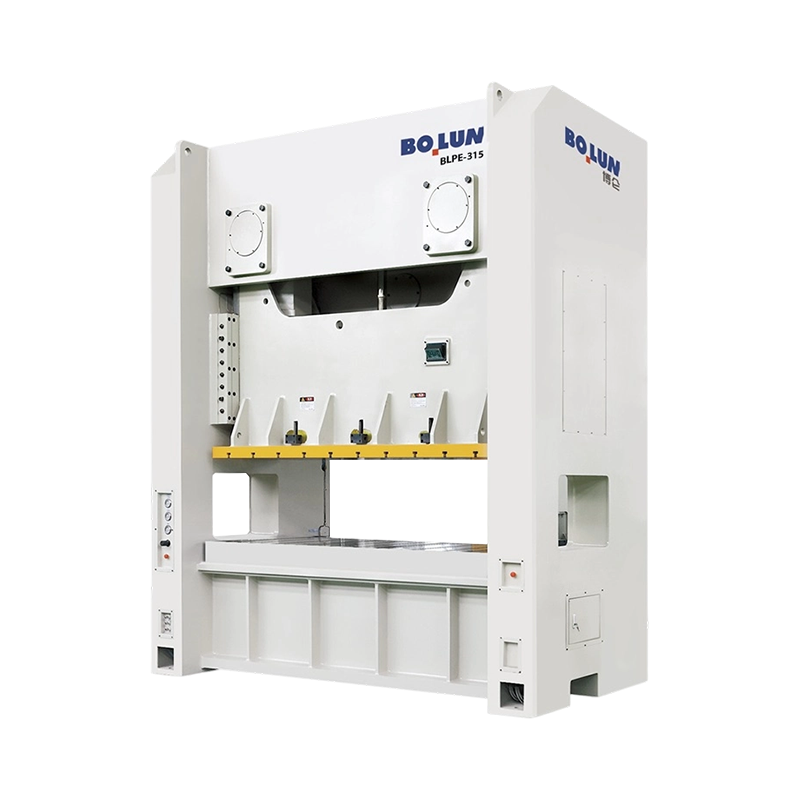
Bolun’s heavy-duty series, featuring the BLPC and BLPE models, represents the ultimate solution for high-precision, high-tonnage stamping environments. Engineered for durability and digital integration, these machines are designed to excel where standard equipment fails.
BLPC Series: High-Performance Double-Point Precision Press
The BLPC series is specifically engineered for wide-table applications and complex multi-station tooling.
Superior Anti-Eccentric Loading: Utilizing a dual-point drive mechanism, the BLPC series offers exceptional resistance to eccentric (off-center) loads. This ensures the slide remains perfectly horizontal even when using wide or unbalanced progressive dies, significantly reducing tool wear and ensuring consistent part quality across the entire bolster area.
Large-Scale Versatility: The expanded bed area is optimized for large automotive panels and appliance housings, allowing for more complex part geometries and integrated stamping processes in a single setup.
Vibration Damping: Its robust double-point architecture naturally dampens harmonic vibrations, protecting delicate die components and ensuring a stable, low-noise production environment.
BLPE Series: Ultra-Rigid Closed-Type (H-Frame) Precision Press
The BLPE series is the "Gold Standard" for heavy-duty blanking and precision forming where zero deflection is mandatory.
H-Frame "Zero-Deflection" Design: The symmetrical, closed-type H-frame structure virtually eliminates the "angular opening" common in open-back presses. This ensures perfect vertical alignment between the punch and die, which is critical when processing high-strength alloys or thick materials exceeding 3.2mm.
Micron-Level Repeatability: The ultra-rigid foundation provides the stability required for high-speed automated lines, maintaining extreme precision even under maximum tonnage.
Long-Term Reliability: Designed for heavy blanking and deep drawing, the BLPE series handles massive impact loads with ease, making it the preferred choice for 3-shift high-frequency production.
Engineering Excellence & Automation
Both series are equipped with forged 42CrMo alloy steel crankshafts and CuSn12 tin bronze bushings for maximum service life. Integrated with PLC-based smart controls, they offer seamless "Handshaking" with NC servo feeders and robotic systems, providing a complete "Smart Factory" solution for modern manufacturers.
As China Closed-Type Double-Point Press Manufacturers and Closed-Type Double-Point Press Suppliers, Zhejiang Bolun High-Precision Machinery Co., Ltd. is located in Zhejiang, the heart of China’s precision manufacturing. With two decades of deep roots in the machinery manufacturing industry, the company has leveraged profound industry accumulation and technical breakthroughs to evolve into a modern, leading enterprise in high-precision forming equipment. We integrate R&D, design, production, sales, and service. From our early days of persevering through challenges to our current leadership in the fields of forging and casting machinery, Bolun Machinery has established a professional, mature, and efficient production management system. We are dedicated to providing global customers with superior industrial machine tool solutions.
 More About Us
BOLUN
More About Us
BOLUN

0+
years
Industry Experience

0+
Units Produced (Previous Year)

0+
Number of Employees

0+
$
Million Annual Output Value

Put a 160-ton open-frame press and a 160-ton closed-frame press side by side and the difference is visible from thirty feet away. One leaves the die area open on three sides so an operator can slide a wide blank in by hand; the other wraps the same die inside a box of stress-relieved steel that barely flexes at full l...
Start With the Purchase Decision, Not the Definitions A procurement engineer comparing a 200-ton hydraulic press quote with a 200-ton mechanical power press quote often finds two different machines, two different cost structures, and two different production promises, even when the tonnage number is identical. That ha...
A tooling engineer quotes a new bracket program and specifies a 160-ton press. The die is built, the machine is installed, and on the first production run the slide stalls six millimetres above bottom dead centre. Nothing is broken. The tonnage was rated at the bottom of the stroke, and the work is being done higher u...
In high-capacity industrial stamping, the wider bolster bed of a closed-type double-point press is designed to handle large progressive dies or multiple separate die sets within a single setup. Unlike single-point configurations, this machine utilizes two distinct connection rods to transmit driving force from the crankshaft assembly directly to the slide. When operating under high-frequency continuous impacts, these two separate forces must remain completely synchronized in terms of both position and velocity. If one connection point lags behind the other by even a fraction of a millimeter, the slide will experience a severe tilting moment. This tilt shifts the punch relative to the lower die, creating asymmetrical clearance that causes premature tool wear, localized stress concentration, and geometric defects in the stamped parts. Keeping these dual points in perfect vertical alignment under dynamic, high-vibration conditions is a fundamental mechanical challenge in press design.
The synchronization challenge is compounded when processing materials that generate uneven resistance. If a progressive die performs heavy blanking on one side of the bed while executing light bending on the other, the press slide is subjected to off-center loading. This uneven resistance places greater physical compression on one connection rod than the other, threatening to disrupt the parallel travel of the slide. To counteract these asymmetrical reaction forces, the drive train of the press must incorporate physical mechanical linkages and electronic monitoring systems that work together to prevent any angular deviation during the rapid downward stroke.
The foundation of physical synchronization is the structural layout of the main drive shaft. Modern closed-type double-point presses utilize either a single massive eccentric crankshaft or twin synchronized crankshafts rotating in opposite directions. When a twin-shaft configuration is employed, the gear train is designed with tight-backlash helical gears that link the rotating shafts together. This physical gearing ensures that the rotation angle of the left connection eccentric remains identical to the rotation angle of the right connection eccentric throughout the entire 360-degree cycle. This mechanical coupling is designed to withstand severe torsional twisting, keeping the physical movement of the two slide connection points locked together regardless of the impact speed.
In addition to gear design, the torsional rigidity of the crankshafts themselves plays a major role in preventing lag. Zhejiang Bolun High-Precision Machinery Co., Ltd. utilizes high-strength forged steel alloys that are precision-ground and heat-treated to resist elastic twisting under peak loading. By minimizing the torsional deflection within the drive shafts, the mechanical synchronization of the dual connection points is maintained even at operating speeds exceeding hundreds of strokes per minute, protecting the internal drive components from fatigue and preventing parallel deviations in the slide movement.
While mechanical gearing coordinates the rotational input, managing the actual force distribution at the connection points requires active hydraulic regulation. A closed-type double-point press is typically equipped with a dual-chamber hydraulic overload protection system, with separate high-pressure oil chambers located directly beneath each connection rod inside the slide assembly. If an obstruction or severe off-center load occurs, the pressure in the affected chamber rises rapidly. If this pressure exceeds a calibrated threshold, a fast-release valve opens in milliseconds to dump the oil, letting that specific side of the slide collapse slightly to prevent structural damage to the frame or tooling.
During standard non-overload operations, these hydraulic chambers also function as a micro-level balance mechanism. The control system monitors the hydraulic pressure of each chamber in real-time, allowing engineers to identify any significant load imbalances across the bed. By ensuring that the hydraulic cushion remains stable and fully pressurized, the press limits the impact of structural clearances within the connection pin bushings, allowing both rods to transmit force symmetrically during high-speed, continuous operations.
Different drive and guide setups provide varying levels of support for slide synchronization when subjected to continuous dynamic impacts. The table below compares the typical characteristics of these configurations in a closed-type double-point press.
| Drive Train Configuration | Guiding System Type | Resistance to Off-Center Loads | Torsional Backlash Range (Degrees) | Effect on Slide Synchronization |
|---|---|---|---|---|
| Single Crankshaft with Dual Rods | Standard Six-Point Gibbing | Moderate | 0.08 to 0.12 | Sufficient for general, low-frequency drawing |
| Twin Counter-Rotating Crankshafts | Extended Eight-Point Gibbing | High | 0.03 to 0.05 | High synchronization accuracy at high speeds |
| Direct-Drive Twin Servo Motors | Full-Length Twelve-Point Gibs | Very High | Under 0.01 (Electronic) | Dynamic compensation for extreme off-center loads |
While the internal drive train provides the downward force, the external guide rails are the physical components that restrict horizontal and angular rotation of the slide assembly. A closed-type double-point press is designed with long, multi-face guide gibs that run along the inside of the four vertical columns. By utilizing eight-point or twelve-point adjustable gibs lined with high-wear bronze alloy or composite materials, the sliding clearances are kept extremely small. This tight clearance physical restricts any tendency of the slide to tilt, even when the dual connection rods experience unequal vertical forces.
To ensure that these tight clearances do not cause binding as temperatures rise during continuous runs, automatic lubrication channels are integrated directly into the guiding surfaces. Bolun Machinery implements centralized lubrication systems that deliver a constant, metered flow of cooled oil to each guide interface. This continuous lubrication reduces friction, dissipates heat, and maintains consistent clearances across the entire height of travel. This stability prevents local thermal expansion from altering the guiding geometry, ensuring that the physical constraints keeping the slide parallel remain reliable over long operational shifts.
During high-frequency continuous stamping, the sudden breakthrough of the metal at the point of shear creates a violent downward release of energy, often referred to as snap-through shock. This shock wave travels upward through the connection rods, causing sudden tensile stress on the drive components and crankshaft bearings. To prevent this reverse shock from destabilizing the synchronization of the dual connection points, the press is equipped with pneumatic balancer cylinders. These cylinders exert a continuous upward force on the slide assembly, keeping the drive connection bearings pre-loaded in a single direction.
By eliminating the mechanical play, or backlash, within the crankshaft and connection pin clearances, the pneumatic balancers ensure that the downward force from both connection points is applied instantly and symmetrically at the moment of impact. This continuous tension prevents the slide from dropping unevenly or vibrating during the transition from compression to tension, which is essential for preserving tool alignment and reducing physical wear on the drive gear teeth over millions of continuous production cycles.
Q: How do the twin synchronized crankshafts in your closed-type double-point press prevent slide tilting during off-center progressive stamping?
A: Zhejiang Bolun High-Precision Machinery Co., Ltd. designs these presses with counter-rotating crankshafts linked by high-precision, low-backlash helical gears. This mechanical coupling ensures that both connection points receive identical rotational input and travel in absolute synchronization, providing robust resistance to off-center loads and maintaining slide parallelism across wide bolster areas.
Q: What mechanism protects the dual connection rods from mechanical failure if one side of the tooling encounters an unexpected obstruction?
A: Our closed-type double-point press integrates a dual-chamber hydraulic overload protection system, featuring separate high-pressure chambers beneath each connection rod. If a localized overload is detected, a rapid-release valve dumps the hydraulic oil in milliseconds, allowing the slide to collapse slightly on the affected side to prevent catastrophic structural damage to the drive train and the dies.
Q: How does the pneumatic balancing system on Bolun Machinery presses manage the heavy weight of large-scale upper die sets?
A: The press features heavy-duty pneumatic balancer cylinders that apply a continuous upward tensioning force on the slide assembly. This upward force offsets the weight of the tooling and slide, effectively removing mechanical play within the crankshaft bearings and connecting pin bushings to ensure a stable, vibration-damped downward impact.
Q: How does your production management system ensure that the large welded frames of these double-point presses maintain long-term geometric precision?
A: After the heavy-duty steel plates are welded into the box-type closed frame structure, the assembly undergoes a comprehensive thermal annealing process to relieve internal material stresses. Our manufacturing system ensures that every frame is structurally stabilized before final machining, preventing the columns from slowly distorting under continuous, high-frequency impacts.
Q: What measures prevent thermal expansion in the guide rails from causing mechanical binding during 24/7 continuous operations?
A: The slide is guided along its path by extended, full-length multi-face gibs backed by an automatic, centralized oil lubrication system. By circulating a cooled, pressurized film of oil across the sliding surfaces, the system dissipates heat generated by friction, maintaining stable guiding clearances and preventing thermal warping under rapid continuous runs.
Contact Us

+86-575-83362228

+86-13735238388

+86-575-83362999

+86-15158259588

Hangzhou Office Add: No. 332 Wangjiang East Road, Shangcheng District

No.1 Linjiang Road East, Xiaren, Jinting Town, Shengzhou City, Zhejiang Province, China
Ready to Begin?
Get in Touch

Now!

ZHEJIANG BOLUN
 English
 中文简体
中文简体