
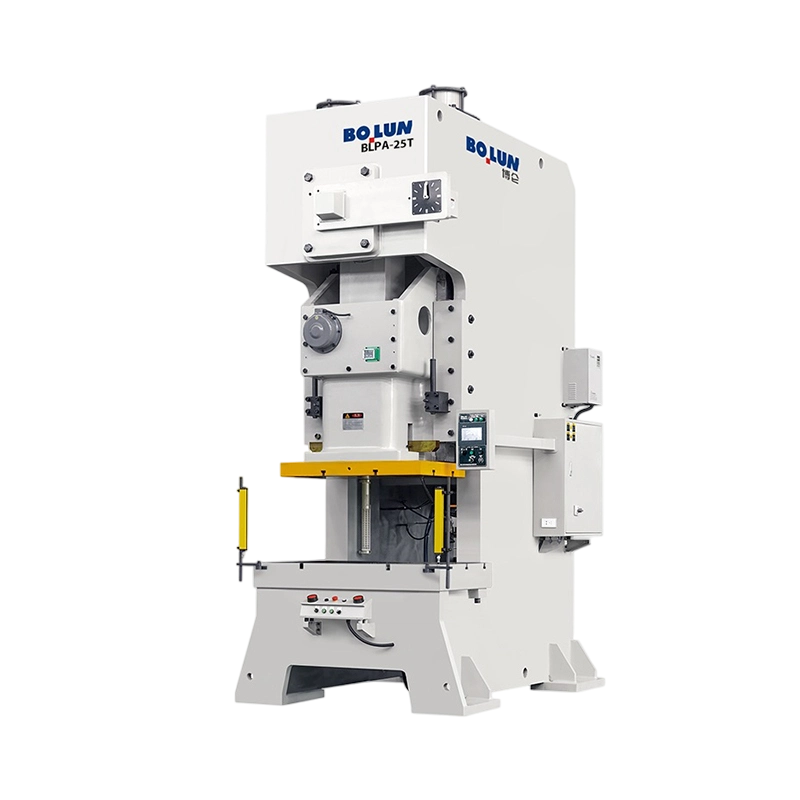


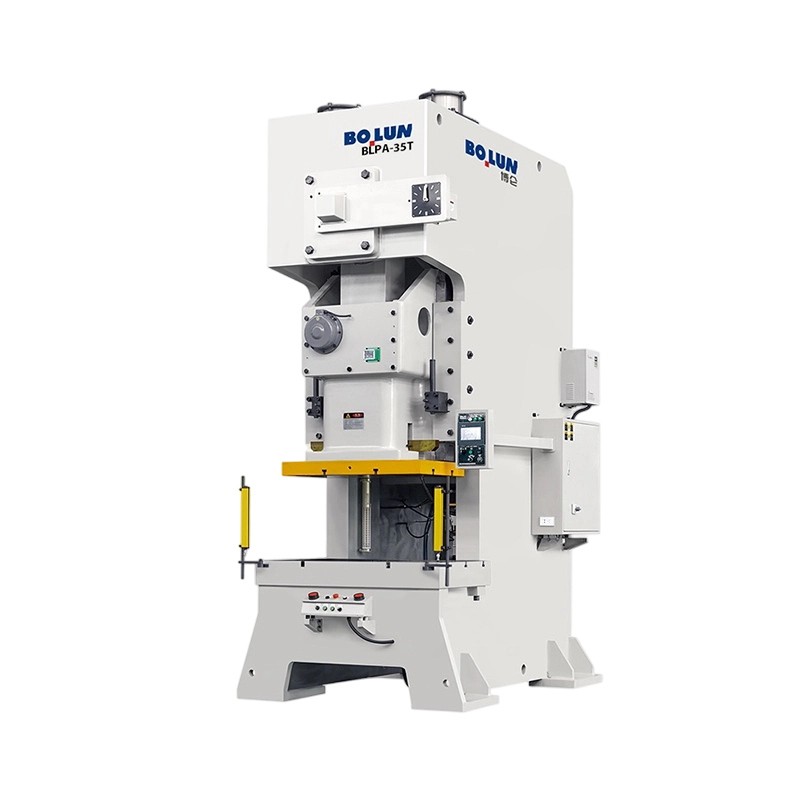
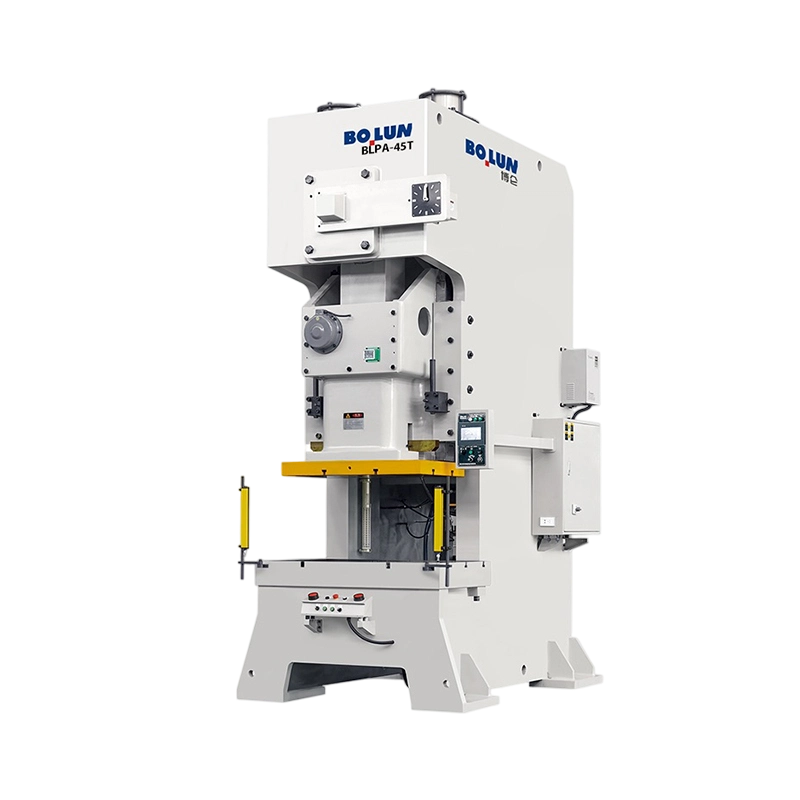
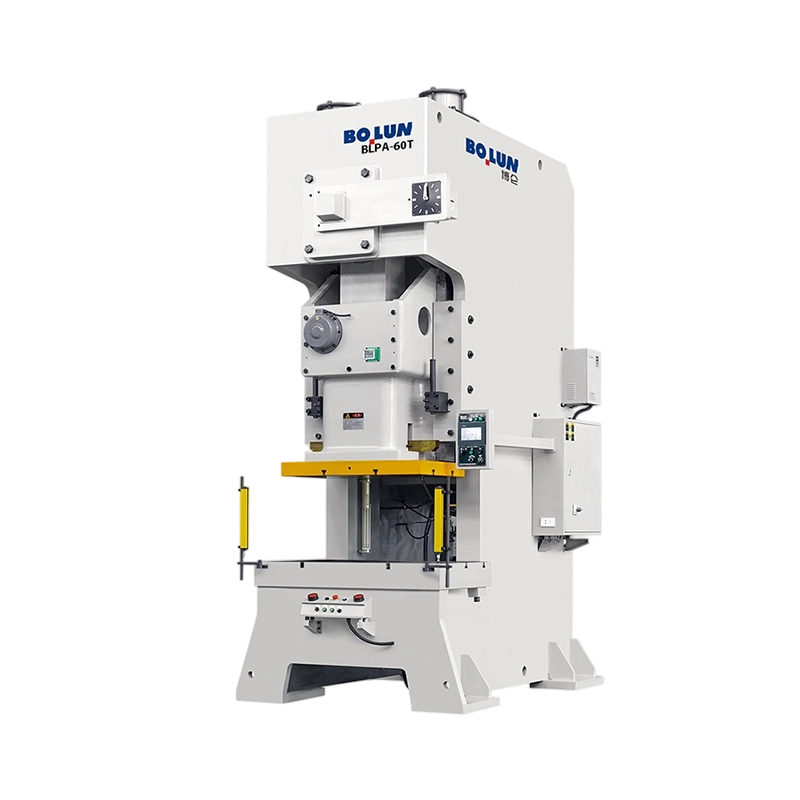
Our BLPA Series Open-Type Single-Point Power Press represents the pinnacle of precision, reliability, and efficiency in modern metal forming. Specifically designed to handle rigorous stamping tasks—such as the 3.2mm thick material processing common in automotive and appliance industries—this machine is your ultimate partner for high-output production.
High-Rigidity Structural Integrity
The machine features a high-tensile, steel-plate welded frame that undergoes a specialized heat treatment process for stress relief. This ensures maximum structural rigidity and minimal deflection under heavy loads, directly resulting in superior part accuracy and significantly extended tool life.
Superior Transmission & Core Components
At the heart of the press is a forged 42CrMo alloy steel crankshaft, offering exceptional fatigue resistance compared to traditional cast components. Coupled with high-grade CuSn12 tin bronze bushings, our transmission system ensures smooth power delivery and reduced heat generation, even during continuous three-shift operations.
Advanced Pneumatic Control & Safety
Equipped with a high-performance pneumatic friction clutch and brake unit, the machine provides rapid response and pinpoint stopping accuracy. Safety is paramount; thus, we integrate a dual solenoid safety valve and a hydraulic overload protector to prevent accidental continuous strokes and protect the machine from tonnage spikes.
Precision Guidance for Complex Tasks
The extended 6-sided (or optional 8-sided) long guide rails provide exceptional slide stability. This high-precision guidance minimizes lateral movement, ensuring consistent die clearance even during off-center loading, which is critical for complex progressive die applications.
Seamless Automation Integration
Powered by a PLC-based control system with a user-friendly HMI, our press is fully optimized for synchronization with NC servo feeders and robotic systems. Whether you are producing architectural brackets or automotive components, our equipment offers the flexibility and "Handshaking" capabilities required for a fully automated smart factory.
Choose Bolun High-Precision Machinery—where durability meets digital automation.
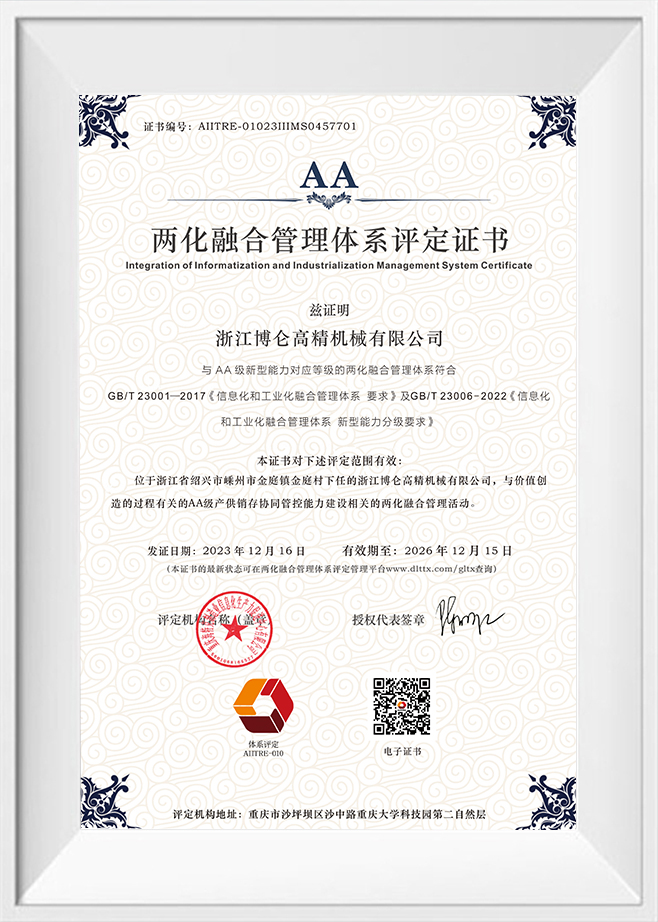
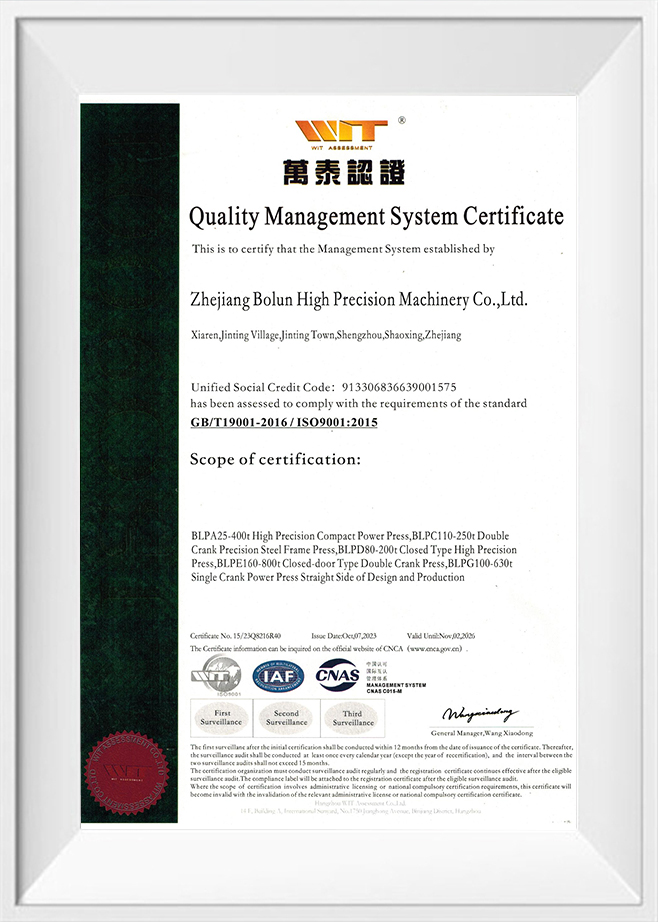
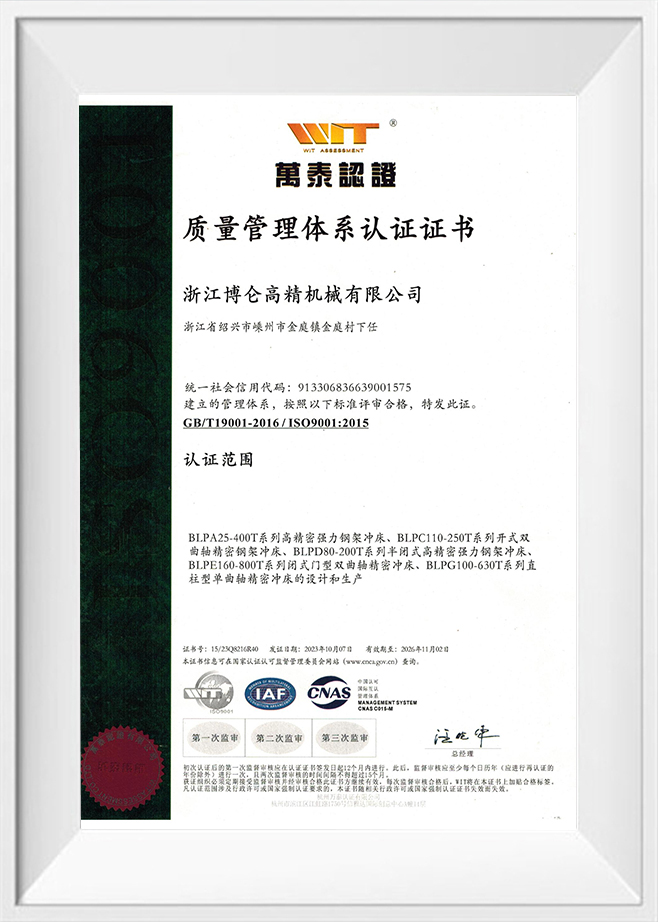
As China Open-Type Single-Point Power Press Manufacturers and Open-Type Single-Point Power Press Suppliers, Zhejiang Bolun High-Precision Machinery Co., Ltd. is located in Zhejiang, the heart of China’s precision manufacturing. With two decades of deep roots in the machinery manufacturing industry, the company has leveraged profound industry accumulation and technical breakthroughs to evolve into a modern, leading enterprise in high-precision forming equipment. We integrate R&D, design, production, sales, and service. From our early days of persevering through challenges to our current leadership in the fields of forging and casting machinery, Bolun Machinery has established a professional, mature, and efficient production management system. We are dedicated to providing global customers with superior industrial machine tool solutions.
 More About Us
BOLUN
More About Us
BOLUN

0+
years
Industry Experience

0+
Units Produced (Previous Year)

0+
Number of Employees

0+
$
Million Annual Output Value

Put a 160-ton open-frame press and a 160-ton closed-frame press side by side and the difference is visible from thirty feet away. One leaves the die area open on three sides so an operator can slide a wide blank in by hand; the other wraps the same die inside a box of stress-relieved steel that barely flexes at full l...
Start With the Purchase Decision, Not the Definitions A procurement engineer comparing a 200-ton hydraulic press quote with a 200-ton mechanical power press quote often finds two different machines, two different cost structures, and two different production promises, even when the tonnage number is identical. That ha...
A tooling engineer quotes a new bracket program and specifies a 160-ton press. The die is built, the machine is installed, and on the first production run the slide stalls six millimetres above bottom dead centre. Nothing is broken. The tonnage was rated at the bottom of the stroke, and the work is being done higher u...
Maintaining slide verticality during high-speed stamping is a fundamental requirement for achieving part accuracy and extending tool life. An open-type single-point power press features a C-frame structure that provides three-sided access to the die area, which is highly advantageous for automated material feeding. However, during high-speed operations, the dynamic forces generated by the rapid reciprocating motion of the slide, combined with the impact force of the punch hitting the sheet metal, create severe vibration and structural deflection. Because the load is applied through a single connection point in the center of the slide, any off-center loading or asymmetrical material resistance can cause the slide to tilt or deviate from its vertical axis of travel. If this deviation is not controlled, it leads to uneven tool clearance, accelerated die wear, and geometric defects in the stamped components.
In high-speed production environments, the slide moves at velocity rates that compound these structural dynamics. Every stroke introduces inertial forces that tend to amplify any slight play or misalignment within the guiding system. A deviation in slide verticality by even a few microns can alter the punch entry angle, resulting in asymmetrical shearing and localized high-stress concentration on the die edges. To counteract these forces, the design of the open-type single-point power press must focus heavily on structural damping, precision guiding, and counterbalancing mechanisms that neutralize dynamic imbalances before they can affect the travel path of the slide.
The foundation of slide verticality lies in the rigidity of the press frame itself. When an open-type single-point power press experiences high-speed impact forces, the C-frame weldment is subjected to angular deflection, which tends to open the throat of the press. This frame flexing directly shifts the guide rails out of vertical alignment. To prevent this, manufacturers like Zhejiang Bolun High-Precision Machinery Co., Ltd. utilize heavy steel plates that are stress-relieved after welding to form a box-type structure. This robust design approach increases the torsional resistance of the frame, ensuring that the upright sections supporting the guide rails remain stable and perpendicular to the bolster plate even under maximum load conditions.
In addition to heavy-duty frame construction, the design of the throat and bed layout is optimized to minimize the moment arm of the forming force. By reducing the distance between the center of the slide and the back frame, the bending moment that causes the frame to flex is minimized. Computer-aided structural modeling allows engineers to distribute material reinforcement precisely to areas experiencing the highest stress concentration. This balanced stiffness profile ensures that any deflection that does occur remains purely vertical, avoiding the angular tilting that directly compromises the vertical travel of the slide during rapid continuous stamping cycles.
While the frame provides the rigid structural backing, the guide gibs are the components that directly control the vertical path of the slide. High-speed open-type single-point power press models utilize long, multi-face guiding systems to constrain slide movement. The length-to-width ratio of the guide gibs is kept high to prevent the slide from pivoting or rocking under off-center loads. Adjustable gibs, often lined with high-wear bronze or composite materials, are machined to exceptionally tight tolerances to minimize lateral clearance. This tight clearance restricts any horizontal displacement of the slide, ensuring it moves straight up and down along the vertical axis of the press.
During high-speed operations, friction between the slide and the guide gibs generates thermal energy, which can cause thermal expansion of the metal. If this expansion is uneven, it can alter the gib clearances, leading to slide binding or excessive play. To manage this thermal factor, modern guiding systems incorporate specialized lubrication grooves and active temperature monitoring. High-precision machining of the guideways ensures that the oil film remains consistent across the entire bearing surface, allowing the slide to maintain its vertical path without stick-slip behavior or structural shifting caused by heat buildup.
High-speed reciprocating motion creates significant vertical inertial forces that can destabilize the press slide. As the crankshaft rotates, the slide accelerates downward, stops at the bottom dead center, and accelerates back upward. This rapid change in momentum exerts upward and downward forces on the press frame and drive train. To neutralize these inertial forces, an open-type single-point power press is equipped with pneumatic balancer cylinders. These cylinders are connected to the slide and apply a constant upward pressure, effectively counterbalancing the combined weight of the slide and the upper die set.
By suspending the weight of the slide assemblies, the pneumatic balancers eliminate the backlash or play within the connection rod bearings and the crankshaft. When the punch impacts the material, there is no sudden transition or take-up of clearance in the drive train, which stabilizes the slide position. This continuous tension prevents the slide from dropping prematurely or tilting at the point of impact, ensuring a smooth, highly vertical entry of the punch into the die. This dynamic balancing is essential for preserving tool alignment at speeds exceeding hundreds of strokes per minute.
The table below provides a comparison of various guiding configurations used in mechanical presses, highlighting how they handle the alignment demands of high-speed operations.
| Guiding Configuration | Gib Alignment Surface Area | Resistance to Off-Center Loads | Thermal Stability under High Speeds | Effect on Slide Verticality |
|---|---|---|---|---|
| Standard Four-Point Gibbing | Moderate | Basic | Moderate | Sufficient for low-to-medium speeds |
| Extended Eight-Point Gibbing | High | High | Excellent | Maintains precise vertical alignment at high speeds |
| Needle-Roller Linear Guides | Very High | Very High | Excellent | Superior vertical precision with minimal friction |
The internal drive train of the open-type single-point power press must also be aligned to support slide verticality. The connection rod, which links the rotating crankshaft to the reciprocating slide, must transmit force along a precise vertical vector. Any misalignment in the crankshaft bearings or the connection pin will introduce a lateral force component that pushes the slide against the guide gibs. High-precision manufacturing processes employed by Bolun Machinery ensure that the crankshaft, connection rod, and slide pin are machined and assembled with absolute concentricity, minimizing lateral thrust forces during operation.
Continuous forced-oil lubrication plays a dual role in maintaining this drive alignment. It forms a high-pressure hydrodynamic film between all moving joints, reducing friction-induced wear that could lead to physical clearances inside the drive mechanism over time. Because even a minute amount of wear in the crankshaft bushings can translate into significant play at the slide level, a continuous supply of clean, cooled lubrication oil is circulated to the critical load-bearing areas. This consistent lubrication barrier prevents metal-to-metal contact, ensuring the mechanical tolerances of the drive train remain intact over millions of cycles, which in turn preserves the vertical accuracy of the slide stroke.
Q: What design modifications are implemented in an open-type single-point power press to preserve slide verticality under high-speed dynamic impacts?
A: To prevent tilt and lateral deviation during rapid continuous cycles, Zhejiang Bolun High-Precision Machinery Co., Ltd. equips these presses with extended multi-face guide gibs machined to tight clearance tolerances. This configuration, paired with heavy-duty pneumatic counterbalancers, eliminates backlash in the drive connection and keeps the slide movement strictly perpendicular to the bed plate.
Q: How does the frame structure of Bolun Machinery presses handle the rotational forces generated by off-center loading?
A: Our open-type single-point power press frames are engineered using thick, stress-relieved steel plates formed into a rigid box-type structure. Through detailed finite element analysis, the throat area is reinforced to resist angular deformation and bending moments, effectively containing the forces of off-center stamping within the vertical plane.
Q: What measures prevent thermal expansion in the slide guides of these presses during continuous, high-volume production?
A: The press utilizes an automatic forced-oil lubrication system that circulates a continuous, cooled oil film across the gib interfaces. This continuous circulation dissipates heat generated by friction, preventing uneven thermal expansion and maintaining a stable guiding clearance throughout extended operational shifts.
Q: Can the pneumatic balancing system on your open-type single-point power press be adjusted for different tool weights?
A: Yes, the pneumatic balancing pressure is fully adjustable via an integrated control regulator. This allows operators to easily calibrate the upward support force to match the specific weight of the upper die set, ensuring consistent dynamic balance and reduced wear on the drive mechanism.
Q: In what ways do you assist factory operators in integrating these single-point presses with automated progressive feed lines?
A: We offer extensive layout customization, providing adjustable stroke lengths, variable speed drives, and integrated electrical handshake signals. This flexible platform allows our machinery to interface seamlessly with high-speed coil feeders, part transfer units, and scrap removal systems for a highly efficient automated setup.
Contact Us

+86-575-83362228

+86-13735238388

+86-575-83362999

+86-15158259588

Hangzhou Office Add: No. 332 Wangjiang East Road, Shangcheng District

No.1 Linjiang Road East, Xiaren, Jinting Town, Shengzhou City, Zhejiang Province, China
Ready to Begin?
Get in Touch

Now!

ZHEJIANG BOLUN
 English
 中文简体
中文简体