
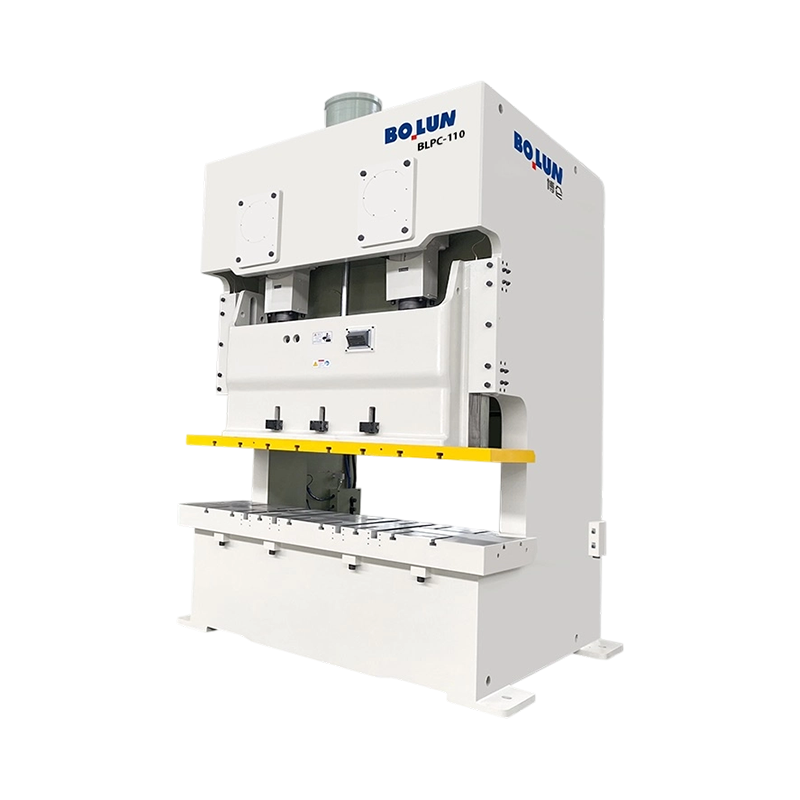


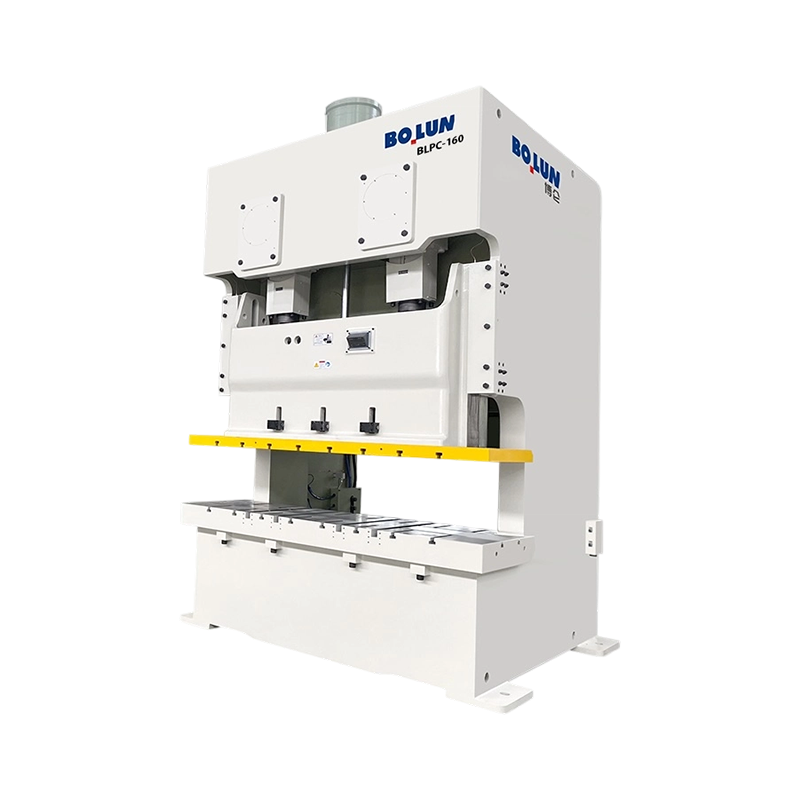
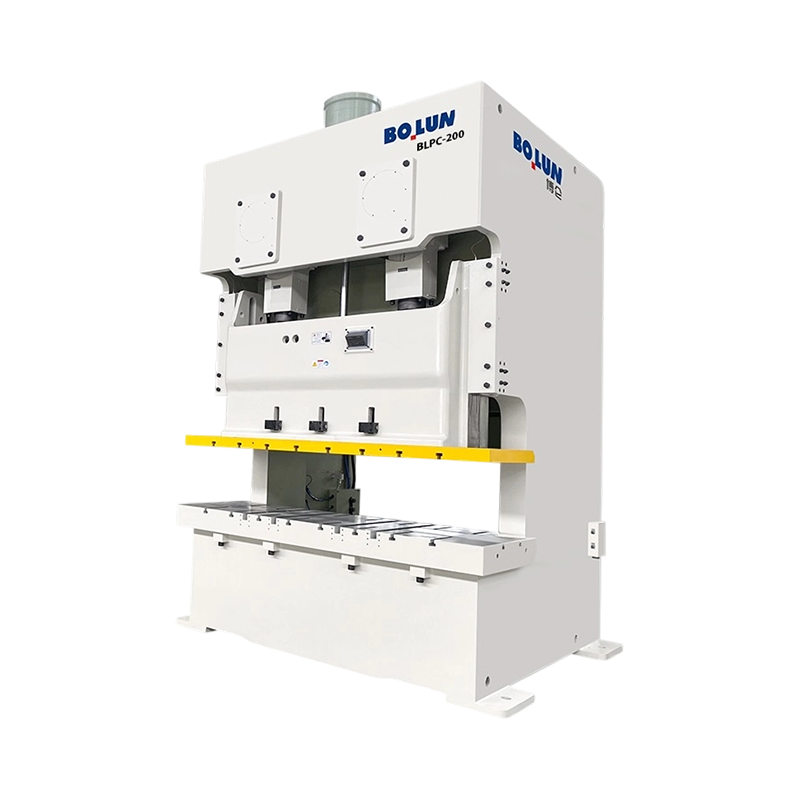
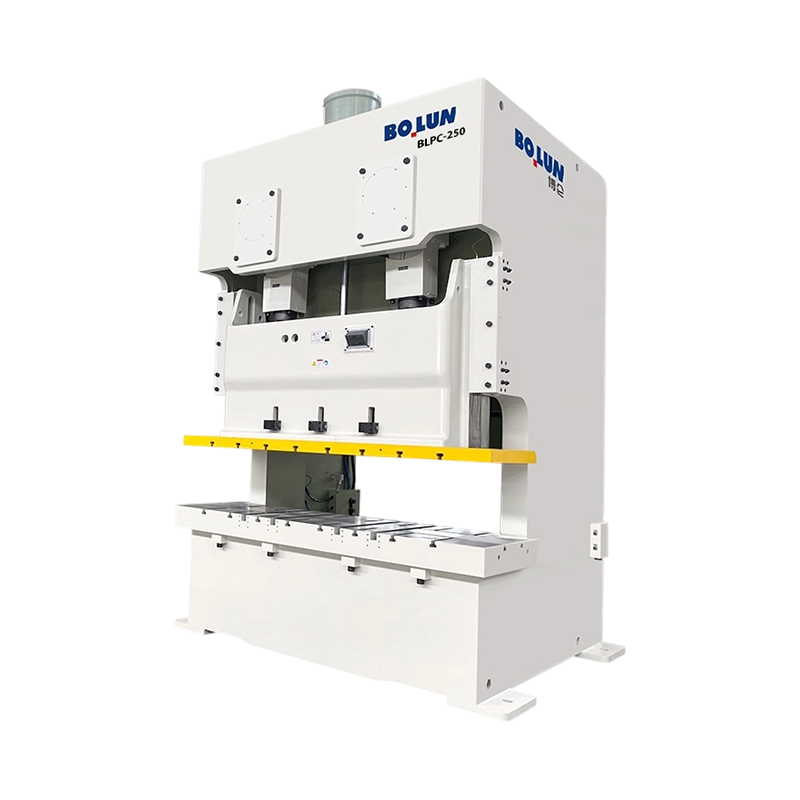
Bolun’s heavy-duty series, featuring the BLPC and BLPE models, represents the ultimate solution for high-precision, high-tonnage stamping environments. Engineered for durability and digital integration, these machines are designed to excel where standard equipment fails.
BLPC Series: High-Performance Double-Point Precision Press
The BLPC series is specifically engineered for wide-table applications and complex multi-station tooling.
Superior Anti-Eccentric Loading: Utilizing a dual-point drive mechanism, the BLPC series offers exceptional resistance to eccentric (off-center) loads. This ensures the slide remains perfectly horizontal even when using wide or unbalanced progressive dies, significantly reducing tool wear and ensuring consistent part quality across the entire bolster area.
Large-Scale Versatility: The expanded bed area is optimized for large automotive panels and appliance housings, allowing for more complex part geometries and integrated stamping processes in a single setup.
Vibration Damping: Its robust double-point architecture naturally dampens harmonic vibrations, protecting delicate die components and ensuring a stable, low-noise production environment.
BLPE Series: Ultra-Rigid Closed-Type (H-Frame) Precision Press
The BLPE series is the "Gold Standard" for heavy-duty blanking and precision forming where zero deflection is mandatory.
H-Frame "Zero-Deflection" Design: The symmetrical, closed-type H-frame structure virtually eliminates the "angular opening" common in open-back presses. This ensures perfect vertical alignment between the punch and die, which is critical when processing high-strength alloys or thick materials exceeding 3.2mm.
Micron-Level Repeatability: The ultra-rigid foundation provides the stability required for high-speed automated lines, maintaining extreme precision even under maximum tonnage.
Long-Term Reliability: Designed for heavy blanking and deep drawing, the BLPE series handles massive impact loads with ease, making it the preferred choice for 3-shift high-frequency production.
Engineering Excellence & Automation
Both series are equipped with forged 42CrMo alloy steel crankshafts and CuSn12 tin bronze bushings for maximum service life. Integrated with PLC-based smart controls, they offer seamless "Handshaking" with NC servo feeders and robotic systems, providing a complete "Smart Factory" solution for modern manufacturers.
As China Open-Type Double-Point Power Press Manufacturers and Open-Type Double-Point Power Press Suppliers, Zhejiang Bolun High-Precision Machinery Co., Ltd. is located in Zhejiang, the heart of China’s precision manufacturing. With two decades of deep roots in the machinery manufacturing industry, the company has leveraged profound industry accumulation and technical breakthroughs to evolve into a modern, leading enterprise in high-precision forming equipment. We integrate R&D, design, production, sales, and service. From our early days of persevering through challenges to our current leadership in the fields of forging and casting machinery, Bolun Machinery has established a professional, mature, and efficient production management system. We are dedicated to providing global customers with superior industrial machine tool solutions.
 More About Us
BOLUN
More About Us
BOLUN

0+
years
Industry Experience

0+
Units Produced (Previous Year)

0+
Number of Employees

0+
$
Million Annual Output Value

Put a 160-ton open-frame press and a 160-ton closed-frame press side by side and the difference is visible from thirty feet away. One leaves the die area open on three sides so an operator can slide a wide blank in by hand; the other wraps the same die inside a box of stress-relieved steel that barely flexes at full l...
Start With the Purchase Decision, Not the Definitions A procurement engineer comparing a 200-ton hydraulic press quote with a 200-ton mechanical power press quote often finds two different machines, two different cost structures, and two different production promises, even when the tonnage number is identical. That ha...
A tooling engineer quotes a new bracket program and specifies a 160-ton press. The die is built, the machine is installed, and on the first production run the slide stalls six millimetres above bottom dead centre. Nothing is broken. The tonnage was rated at the bottom of the stroke, and the work is being done higher u...
An open-type double-point power press distributes force across two distinct connection points on the slide, allowing for wider bed areas and increased resistance to off-center loading. The motion of this machinery is regulated by a heavy-duty pneumatic clutch and brake unit. When the press is running, compressed air is directed into the clutch piston, which engages the drive shaft with the flywheel. Simultaneously, the air pressure overcomes the force of heavy mechanical springs to release the brake. When a stop command is issued, whether manually or via automated sensors, the control system must exhaust the pressurized air immediately. This action allows the mechanical springs to force the brake plates together, halting the movement of the slide. The physical response time depends directly on the speed of the pneumatic exhaust valve and the mass of the dual-point slide assembly. Because the slide in a double-point press is wider and heavier than in a single-point press, managing the inertial forces during stopping sequences requires structured air passage sizing and precise spring calibration to ensure the slide comes to a rest within specified limits.
The synchronization between the clutch release and brake engagement is critical. If there is a overlap where both systems are partially engaged, the friction plates will experience high thermal stress and rapid wear. Conversely, if there is a gap where neither system is engaged, the slide may drift under its own weight, especially when carrying heavy tooling. Modern design principles solve this issue by using a combined clutch-brake unit, which utilizes a single piston to physically prevent simultaneous engagement. This configuration guarantees that as air pressure drops, the transition from driving to braking occurs mechanically and predictably, minimizing the time required to initiate deceleration during safety stops.
During an emergency stop situation, every millisecond determines the total distance the slide travels before coming to a complete halt. The signal path starts when an operator presses the emergency button or when a safety light curtain is interrupted. This electrical signal travels directly to a dual-channel safety PLC, which processes the input within a small window, typically under fifteen milliseconds. Once processed, the controller cuts power to the dual safety solenoid valves. These redundant valves are engineered to exhaust the compressed air from the clutch-brake chamber. The physical release of the air pressure and the subsequent engagement of the friction brake plates represent the mechanical delay portion of the response cycle. For an open-type double-point power press operating under normal load, the total elapsed time from the initial signal to the complete cessation of slide movement generally ranges between one hundred and two hundred and fifty milliseconds. Zhejiang Bolun High-Precision Machinery Co., Ltd. analyzes these sequence parameters during the testing phases to ensure that the braking distance meets international machine tool guidelines.
The speed of the slide at the moment of the stop signal also influences the overall stopping time. At higher operating speeds, the rotational kinetic energy of the crankshaft and the vertical momentum of the slide are greater, which demands more energy dissipation from the brake lining. Consequently, safety zones and light curtain distances must be calculated based on the maximum speed of the press rather than the average operating speed. Designers utilize deceleration calculations that factor in the valve response time, the brake spring tension, and the friction coefficient of the brake lining to establish a safe operating perimeter around the slide area.
Inching, also known as jogging, is an essential operational mode used during mold setup and alignment procedures. In this mode, the slide is moved down in tiny increments through rapid, repeated engagements of the clutch-brake mechanism. The response time during inching is characterized by how quickly the clutch can build up pressure to move the slide, and how rapidly the brake can re-engage to stop it before the slide travels too far. Since the motor runs continuously, the pneumatic control valves must react with high repeatability. If the response time is inconsistent, the slide may overshoot the desired adjustment height, which could result in mold damage or misaligned feeding systems. The pneumatic circuit must be designed to handle these rapid pressure fluctuations without suffering from pressure drops or structural lag. A typical inching signal demands a valve response of under sixty milliseconds to ensure that the operator can control the descent of the slide with accuracy during critical mold setting steps.
During the inching cycle, the press does not reach its full operating speed, meaning the kinetic energy is lower than during continuous operation. However, the frequency of engagement is much higher, which can lead to heat buildup in the clutch-brake assembly. To maintain consistent response times during prolonged setup sequences, the system relies on forced ventilation or cooling passages to dissipate this thermal energy. Keeping the friction surfaces within a stable temperature range ensures that the coefficient of friction remains constant, preventing slide drift or delayed stopping during these precise micro-adjustments.
The physical size of the machine frame and the mass of the slide directly influence the deceleration rates and the total time required to arrest the movement of the slide. The following table provides typical performance metrics observed across different tonnage capacities of these double-point configurations during emergency stop and inching sequences under standard operating conditions.
| Press Capacity (Tons) | Average E-Stop Valve Reaction (ms) | Mechanical Brake Engagement (ms) | Total Slide Stopping Time (ms) | Inching Pulse Response (ms) |
|---|---|---|---|---|
| 110 Tons | 12 to 18 | 85 to 110 | 100 to 130 | 45 to 60 |
| 160 Tons | 14 to 20 | 95 to 125 | 115 to 150 | 50 to 65 |
| 250 Tons | 16 to 22 | 110 to 145 | 130 to 175 | 55 to 75 |
| 400 Tons | 18 to 25 | 130 to 170 | 155 to 205 | 65 to 85 |
Over extended periods of continuous manufacturing, the friction linings on the clutch and brake plates undergo natural, gradual wear. This wear increases the gap between the friction surfaces, which in turn increases the volume of air required to engage the system and extends the mechanical response time. To prevent this wear from compromising operator safety, modern open-type double-point power press units are equipped with automatic brake monitoring systems. These monitors measure the angle of the crankshaft at the moment the stop signal is given and compare it to the angle when the slide actually stops. If the measured stopping time or angle exceeds a predetermined safety threshold, the system locks out further operations, prompting maintenance personnel to adjust the brake clearance or replace the friction pads. Bolun Machinery integrates these monitoring systems to guarantee that the machine remains compliant with established safety standards throughout its service life, preventing unexpected overruns during daily stamping routines.
The integration of these electronic monitors also aids in predictive maintenance. By logging the trend of the stopping times over thousands of cycles, the control software can forecast when the brake linings will require service before a safety critical limit is reached. This data-driven approach minimizes unplanned downtime and ensures that the machine always operates within its certified safety parameters, protecting both the tooling and the operator from potential hazards.
The physical layout of the pneumatic piping within the press frame is another critical factor in determining the response time of the open-type double-point power press. Long air lines between the safety valve and the clutch-brake unit create air flow resistance and volume delays, which can slow down the exhaust cycle. To achieve rapid response times, engineers position the dual safety valves as close to the clutch-brake housing as physically possible. Using large-diameter piping and high-flow mufflers allows the pressurized air to escape into the atmosphere with minimal restriction. This design consideration is vital for keeping the stopping times within the required limits, especially when running high-speed stamping operations where the window for preventing tool collision or operator injury is small.
In addition to piping length, the quality of the air supply must be regulated. Moisture or contaminants in the compressed air can cause the safety valves to stick or sluggishly respond, directly increasing the stopping time. A dedicated air preparation unit consisting of filters, regulators, and lubricators is installed upstream of the safety valves to ensure a clean, dry, and consistent air supply. This maintained pressure stability is essential for ensuring that the pneumatic actuators operate at their designated speeds during both emergency stops and high-frequency inching processes.
Q: What design advantages does an open-type double-point power press offer over single-point models when handling wider stamping dies?
A: By utilizing two distinct connection points on the slide, this configuration distributes the forming force across a much wider surface area. Zhejiang Bolun High-Precision Machinery Co., Ltd. designs these presses to provide exceptional resistance to off-center loading, preventing slide tilt and ensuring highly uniform pressure distribution when running large or asymmetrical progressive dies.
Q: How do the safety systems of Bolun Machinery presses ensure rapid slide deceleration during an emergency stop?
A: Our open-type double-point power press models integrate high-flow dual safety solenoid valves positioned immediately adjacent to the combined clutch-brake unit. This layout minimizes pneumatic line resistance, allowing the pressurized air to exhaust in milliseconds, which immediately engages the heavy-duty mechanical brake springs to halt slide motion rapidly.
Q: How does the drive mechanism of this press maintain high precision and low vibration during rapid inching operations?
A: The press features a dynamically balanced crankshaft and slide system supported by an automatic, high-pressure forced lubrication system. This continuous oil film prevents mechanical play or backlash within the dual connection rods, enabling highly responsive and repeatable micro-adjustments during the mold-setting process.
Q: What measures are in place to monitor and compensate for brake wear over long production cycles?
A: An integrated electronic crank-angle monitoring system continuously measures the stopping angle and time during operation. If the friction linings undergo natural wear and exceed the designated safety threshold, the control system triggers a lockout to alert maintenance, ensuring the machinery always operates within certified safety parameters.
Q: Can the pneumatic balancing pressure on these double-point presses be adjusted to accommodate heavy upper die sets?
A: Yes, our presses are equipped with adjustable pneumatic balancer cylinders that can be calibrated to match the specific weight of varying upper tools. This counterbalancing action offsets the vertical inertia of the slide assembly, reducing stress on the drive gears and preserving precise slide verticality during high-speed stamping.
Contact Us

+86-575-83362228

+86-13735238388

+86-575-83362999

+86-15158259588

Hangzhou Office Add: No. 332 Wangjiang East Road, Shangcheng District

No.1 Linjiang Road East, Xiaren, Jinting Town, Shengzhou City, Zhejiang Province, China
Ready to Begin?
Get in Touch

Now!

ZHEJIANG BOLUN
 English
 中文简体
中文简体