
An open-type single-point power press drives its slide from one connection at the center, which keeps the machine simple and economical for light work, while an open-type double-point power press drives the slide from two connections spaced across its width, which improves load balance, parallelism, and tolerance on wider dies. Single point presses are typically chosen for small blanking, piercing, and light forming up to about 100 tons, while double point presses are usually specified for larger parts and forces from about 100 tons up to roughly 300 tons.
For buyers and plant engineers, the practical decision rests on three questions: how large the die is, how far the force is from the center of the slide, and how strict the tolerance needs to be. A single point press is often the right choice when parts are small and centered, while a double point press is safer and more accurate once the die grows wide or the work is off center.
Central drive, lower cost, centered loads only
Two drives, better balance and accuracy
Both use open C or gap frames
Eccentric load causes tilt and wear
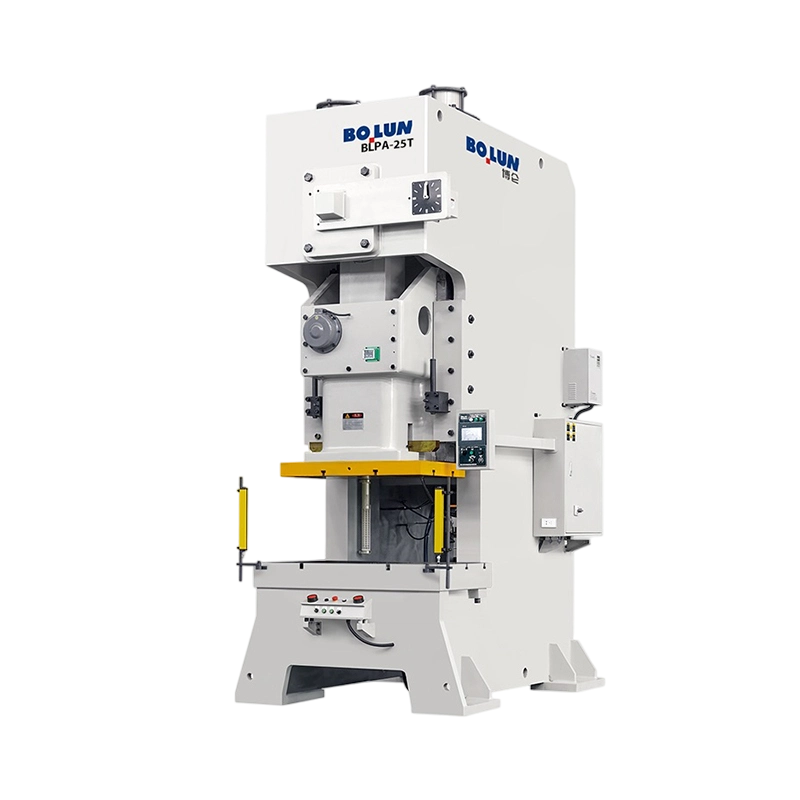
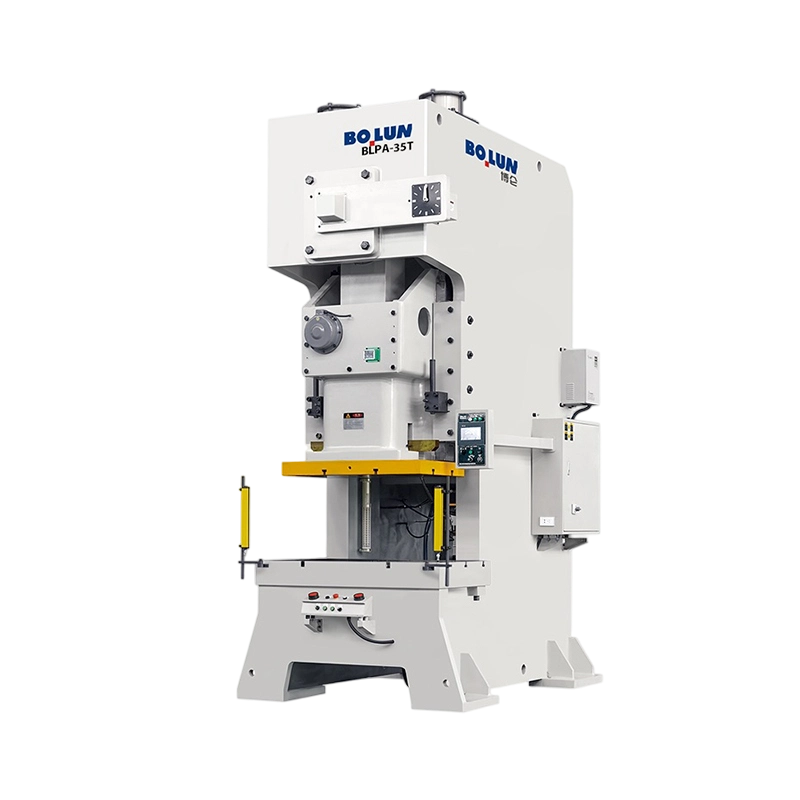
An open type power press machine uses a C shaped frame open on three sides, allowing easy access to the die area, and both single point and double point versions share this frame philosophy while differing in how the slide is driven.
The open throat lets operators and feeding equipment reach the die from the front and sides. This is valuable in job shops and mid sized plants where die changes are frequent. The trade off is that the frame flexes more under load than an enclosed design, so the drive arrangement and the way force is applied become especially important.
In both designs, a crankshaft or eccentric converts the rotation of the flywheel into up and down movement of the slide through one or more connecting rods. The number of connection points determines how forming force reaches the slide, and that single factor shapes the performance, cost, and suitability of each machine.
The open-type single-point power press transmits its entire forming force through one connection point, usually near the center line of the slide, so the die must be aligned precisely with that point to avoid uneven loading.
Because there is only one drive connection, the single point design has fewer moving parts, a simpler crankshaft or eccentric arrangement, and lower manufacturing cost. Maintenance tasks are fewer, which suits smaller plants and shops with limited technical staff.
Single point presses handle small, centered parts such as electrical terminals, small brackets, washers, clips, and simple piercing work. When the force is concentrated near the center of the slide and the die is compact, the machine delivers consistent results at a competitive price.
When the working force sits away from the single connection point, the slide tends to tilt, and this tilt increases with the distance between the force and the drive center. Off center work can therefore cause uneven wear on gibs and guides and produce parts that vary in dimension or flatness. Designers reduce this effect by keeping the die centered, using larger gibs, and limiting the eccentric moment the press is asked to carry.
The open-type double-point power press drives the slide from two connection points spaced across its width, so the force is shared between them and the slide stays more level under load.
Two connecting points, often driven by a common crankshaft or two eccentric shafts, distribute the load across the slide width. This arrangement reduces tilting when the die is wide or when force is not perfectly centered. It also improves parallelism between the slide and bed, which supports tighter part tolerance.
Double point presses suit wider dies, longer blanking lines, progressive dies with multiple stations, and forming operations that place force across a broader area. Automotive brackets, appliance parts, and electrical stamping with multiple features often run more reliably on a double point machine.
The second drive connection adds components, alignment requirements, and maintenance points. Initial cost is higher, and setup requires attention to both connection points so the slide stays balanced. The benefit is greater stability and a wider working envelope.
The comparison below highlights the trade offs that matter most when choosing a drive configuration for an open frame press.
| Characteristic | Single-Point Press | Double-Point Press |
|---|---|---|
| Drive connections | One central connection | Two connections across the width |
| Typical capacity band | Up to about 100 tons | About 100 to 300 tons |
| Tolerance to off center loads | Low, tilts with eccentric force | Good, shares load across slide |
| Parallelism under load | Requires careful die centering | Better maintained across wider dies |
| Relative purchase cost | Lower | Higher |
| Maintenance points | Fewer drive components | More bearings and connections to check |
| Typical parts | Small centered blanks and terminals | Wide brackets and progressive dies |
The location of the working force relative to the drive connection determines whether the slide stays level, so understanding load position is the foundation for choosing between the two designs.
When the die force is centered over the connection point, the single point press behaves almost like an ideal machine, with even wear and stable part dimensions. Small dies placed carefully at the center line are the sweet spot for this design.
An eccentric load creates a moment that tries to tilt the slide. For example, a die whose cutting edges sit 50 millimeters off the drive center on a single point press can produce a noticeable tilt that appears as burrs on one side of the part. Double point presses reduce this moment by dividing the force between two connections, so the same die often runs with less distortion.
Plan die layout so the combined centroid of the cutting force sits as close as possible to the drive center. If the centroid cannot be moved to the center, the design should shift toward a double point machine or add guiding features such as heavier gibs and balanced die elements.
Selection should be based on the parts, the die, and the tolerance requirements rather than on price alone, because a mismatched drive configuration causes repeated problems that cost more than the initial savings.
Measure the die width and the spread of cutting or forming stations. Narrow, centered dies are compatible with single point machines, while wide dies and multi station progressive tools usually need double point support.
Calculate the blanking or forming force from the perimeter, material thickness, and shear strength. Keep a margin of roughly 20 percent below rated tonnage for normal operation. If the peak force is near the single point capacity, a double point press gives more room for variation.
High volume parts with tight tolerances benefit from the stability of a double point press, because parallelism is maintained for longer between checks. Low volume prototype or short run work can often be handled economically on a single point machine.
Tonnage describes only part of a press, so buyers should evaluate stroke, shut height, bed size, and energy capacity together with the drive configuration.
Manufacturers rate tonnage at a specified distance before bottom dead center. Forming work that needs maximum force at a different stroke point may exceed the safe capacity, so the rating point should match the process requirement.
Stroke length should accommodate the longest part and the feeding equipment, while shut height must include the die set height and any parts stacking. Double point presses with larger frames may offer more shut height options for progressive tooling.
| Specification | Why It Matters | Question to Ask Supplier |
|---|---|---|
| Rated tonnage and rating point | Sets maximum safe force | At what stroke distance is the rating valid? |
| Allowable eccentric load | Limits off center work | What is the maximum moment for this frame? |
| Slide parallelism specification | Controls part accuracy | What tolerance is guaranteed at full load? |
| Strokes per minute | Production capacity | Is this rate valid for the rated tonnage? |
| Bed and bolster dimensions | Die size and mounting room | What die set sizes fit without modification? |
Die design and drive configuration must be considered together, because a die that performs well on one machine can produce poor parts on another.
Place the die so that the combined cutting force falls close to the drive center. Guide pillars and bushings should be sized for the expected side load, and the die shoe should be wide enough to keep the punch and die aligned under the slide.
Progressive dies spread force across several stations. On a double point press, arrange the stations so that the load is distributed evenly between the two connection points. Uneven station loads can still produce moment effects, so force calculations should be checked for each station.
Heavier guide systems and hardened wear surfaces help control misalignment on both designs. Regular inspection of guide pillars, bushings, and gib surfaces keeps the die moving smoothly and protects part quality over long runs.
Setup accuracy determines whether either configuration achieves its design performance, and alignment checks should be built into every die change.
Clean the bolster and die shoe, position the die by its centerline marks, and clamp it evenly with specified torque. Set shut height to the die specification and confirm closure with a feeler gauge before running at production speed.
Check parallelism between slide and bed using dial indicators at several points across the bed. Double point presses should show consistent readings across the width, while single point presses may show larger variation if the die is off center. Record readings to identify drift over time.
On a double point press, both connection points must engage consistently. Check connecting rod length, bushing condition, and drive timing so that the slide does not twist during the stroke. Inconsistent timing shows up as uneven part features and abnormal noise.
Maintenance demands grow with the number of drive connections, so double point presses require more planned inspection than single point machines.
Focus on the central connection bearing, gib clearance, clutch and brake condition, and lubrication of the main crankshaft. Because the load is concentrated, gib wear and guide wear should be checked frequently when running off center dies.
Inspect both connection bearings, both connecting rod assemblies, and both sets of gibs. Check that lubrication reaches every point and that the two sides wear at similar rates. Uneven wear between the sides is an early warning sign that alignment or die loading needs attention.
Open frame presses still create serious crush and entanglement hazards, and the safety system must match the drive configuration and feeding method.
Use fixed guards, interlocked guards, light curtains, or presence sensing devices that prevent hand entry during the stroke. The open throat must be managed carefully because it provides access to hazards from several directions.
Two hand controls keep both hands away from the die during the stroke. Measure stopping distance and stopping time regularly, since brake wear changes these values. A press that overruns can damage tooling and endanger operators.
Operators and maintenance staff need training on die handling, setup procedures, and lockout tagout before any internal work. Follow the machine guarding requirements that apply in your country, such as OSHA rules in the United States or relevant European directives.
Real applications show how the two configurations are used in daily production, and the examples below reflect common practice rather than specific machine models.
A small single point press running a centered blanking die can produce terminals at high stroke rates. Because the parts are small and the force is well centered, the single point design gives reliable output at a lower equipment cost.
Wider brackets with multiple piercing and forming features often run on double point presses. The shared load and better parallelism help hold hole position and flatness across long production runs.
Appliance parts that combine blanking and bending on a broad die area frequently benefit from double point machines. Consistent force distribution reduces springback variation and improves assembly fit.
Purchase price is only one part of the decision, and total ownership cost includes scrap rate, die life, maintenance labor, and downtime.
For centered small parts, a single point press can deliver the lowest total cost, because its simpler drive and lower capital price suit short run and low complexity work. Savings disappear quickly if off center dies cause frequent scrap or early tooling wear.
A double point press often pays back through lower scrap, longer die life, and fewer accuracy complaints on wide or high volume parts. Its higher purchase price is justified when production runs are long and tolerance requirements are strict.
Most drive related problems show up as uneven parts, abnormal wear, or noise, and a structured check finds the cause faster than trial and error.
One sided burrs often indicate tilt caused by off center load on a single point press, or uneven parallelism on a double point press. Check die centering first, then verify parallelism and gib clearances.
Heavier wear on one gib indicates eccentric loading or misalignment. Adjust die position, reset clearances, and inspect guide surfaces. Replacing worn gibs before they damage the slide prevents costly repairs.
Knocking can come from worn connection bushings, loose fasteners, or timing differences between connection points. Stop the press, inspect each connection, and confirm bushing clearances before resuming production.
Question: What is an open-type single-point power press?
It is an open C frame press that drives the slide from one connection point near the center, offering simple construction and low cost for centered, light duty work.
Question: What is an open-type double-point power press?
It is an open frame press that drives the slide from two connection points across its width, sharing the load and improving parallelism on wider dies.
Question: Why does off center loading cause problems on single point presses?
Off center force creates a moment that tilts the slide, which causes uneven gib wear, burrs on one side of parts, and dimensional variation.
Question: What capacity do single point presses typically cover?
Single point presses are commonly used up to about 100 tons, depending on frame size and design, with the exact rating defined by the manufacturer.
Question: When should a double point press be chosen?
Choose a double point press for wide dies, progressive tooling, off center forces, and tight tolerance parts produced in long runs.
Question: How does the open frame affect accuracy?
An open frame flexes more under load than a closed frame, so drive configuration, die centering, and parallelism checks become especially important for accuracy.
Question: How do I calculate the force needed for a blanking operation?
Multiply the cut perimeter by material thickness and shear strength, then add forming requirements and a safety margin of about 20 percent below rated capacity.
Question: What maintenance is different on double point presses?
Double point presses require checks on both connection bearings, both connecting rods, and both sets of gibs, plus confirmation that the two sides wear at similar rates.
Question: What causes one sided burrs on a stamped part?
One sided burrs usually point to tilt from off center loading or uneven parallelism, and the fix starts with checking die centering and gib clearances.
Question: Is a single point press cheaper to own?
For centered small parts with careful die layout, a single point press often has lower total cost, but off center work can erase that advantage through scrap and tool wear.


A tooling engineer quotes a new bracket program and specifies a 160-ton press. ...
Understanding Mechanical Power Presses and Their Essential Functions A mechani...
A buyer comparing a 45-ton open-gap press for a bracket line often receives two...
A fastener plant in Taizhou receives a request from an automotive tier-one supp...
The Short Answer: Which Frame Type Suits Your Work An open type power press mac...
Put a 160-ton open-frame press and a 160-ton closed-frame press side by side an...
Contact Us

+86-575-83362228

+86-13735238388
+86-18667502750

+86-575-83362999

+8618667502750

No.1 Linjiang Road East, Xiaren, Jinting Town, Shengzhou City, Zhejiang Province, China
Ready to Begin?
Get in Touch

Now!

ZHEJIANG BOLUN
 English
 中文简体

