
A fastener plant in Taizhou receives a request from an automotive tier-one supplier: 8 million socket-head cap screws in grade 10.9, delivered over fourteen months. The plant's machining route is too slow, the material losses too high, and the grain-flow properties of cut threads do not satisfy the fatigue requirements. A week later the plant signs the tooling order for a cold forming press.
That sequence is repeated thousands of times across the industry. When production volumes rise and the ratio of material cost to labor is high, the answer is cold forming, and the machine that performs it, the cold forming press, turns out to be a family of presses with very specific mechanical characteristics rather than a single generic design.
In short: a cold forming press is a metal forming machine that shapes blank or wire material at room temperature using a die set and high compressive force, and its most effective configuration for heavy work is the toggle-driven press, which multiplies force at the bottom of the stroke. The rest of this article explains what that means, what the common variants are, how to compare them, and how to size one for a real part.
A cold forming press is a press machine that applies compressive force to metal at ambient temperature, causing the material to flow plastically into a die cavity. The process does not produce chips, does not require workpiece heating, and is classified under cold forging when the deformation is severe. Extrusion, upsetting, coining, and ironing are all typical operations. The term cold forming press is used interchangeably with cold forging press in many equipment catalogs.
The conclusion comes first: if your part is a bolt, a nut blank, a bearing race, a ball stud, an electrical connector, or any symmetrical component made in volumes above 50,000 pieces per year, cold forming will almost always produce it faster, with less material input, and with better mechanical properties than machining. The press is the foundation of that economic logic.
Three facts define the economic case. First, material yield: cold forging uses 20 to 40 percent less material than machining for the same finished part because metal is displaced rather than removed. Second, productivity: a single cold forming press produces parts at 20 to 200 strokes per minute, depending on the part size and machine type. Third, strength: because the grain flow is continuous along the part contour instead of being cut, fatigue performance improves by a measurable margin, frequently 20 to 30 percent in fatigue tests compared with machined parts.
There are also boundary conditions. Cold forming requires the material to be ductile enough to deform at room temperature. Low- and medium-carbon steels, annealing-grade alloy steels, stainless steels in the 300 series, aluminum alloys up to medium strength, and copper alloys dominate the practical list. High-carbon or brittle materials are not candidates. The press force must also be high relative to a stamping press of the same size, and the machine structure must be correspondingly rigid. That is why the buyer hears "cold forming press" as a dedicated equipment category instead of a generic press. For a deeper look at the process relationship, see our industry note on what a cold forging press machine does before comparing models, because the same manufacturer that builds stamping presses may build a separate toggle line for cold work.
The working principle of a mechanical cold forming press is straightforward in concept. A flywheel stores rotational energy. A clutch connects that energy to a gear train, and the gears drive a mechanism that converts rotation into the reciprocating motion of a slide. The slide carries the punch; the die is mounted on the bolster or bed. When the press cycles, the punch enters the die cavity and forces the blank to flow into the desired shape.
The distinguishing variable is the mechanism that converts rotation into slide motion. A standard crank press uses a crankshaft: the slide moves faster in mid-stroke and slows near bottom dead center, and the available force rises gradually to a maximum very close to the bottom. A toggle press uses a set of links arranged so that as the crank rotates, the links nearly straighten at the bottom of the stroke. In that final phase the mechanical advantage becomes enormous: a relatively small force from the gear train is multiplied into a very large force at the slide.
That mechanical arrangement produces exactly the force curve cold forming needs. Upsetting, forward extrusion, and coining all require the peak force in the last few millimeters of the stroke, after the material has filled the die and work hardened. The toggle press delivers high tonnage over the final portion of the stroke while keeping the slide speed low at the point of contact. Low velocity at contact means longer die life and more time for the material to flow instead of fracture.
A second benefit is the "balanced stroke" characteristic that toggle press datasheets often mention. Because the toggle geometry distributes the contact velocity and acceleration evenly across the working zone, the press does not slam into the blank as abruptly as a crank press with the same tonnage would. This reduces hammering in the frame and often correlates with better dimensional consistency across a batch.
There is also an energy aspect. The flywheel is sized to deliver the forming energy without excessive speed drop. In continuous operation, the motor re-accelerates the flywheel between strokes. If the motor cannot recover enough energy in the available time, the press stalls at a nominal tonnage below its nameplate rating. This is the reason a cold forging line must evaluate energy capacity in joules per stroke, not only tonnage, a point we return to in the specifications section.
Many shops begin with a general-purpose crank press, attempt a cold extrusion operation, and report die breakage, frame hammering, or insufficient force at the end of the stroke. The differences are not subtle.
A crank press develops force as roughly the sine of the crank angle. The slide reaches maximum speed at mid-stroke and maximum force only within about 15 to 30 degrees before bottom dead center. The working energy is delivered in a short window. A toggle press, in contrast, uses the straightening links to produce high force throughout the lower portion of the stroke, typically over 40 to 60 degrees of crank rotation. The usable forming zone is longer, and the force is available where the work actually happens.
In practice, that changes every process decision: the tool design can use a slower material flow rate at high pressure; the die is loaded more uniformly; and the press can handle continuous heavy shocks at higher stroke rates without the same level of vibration. The table below summarizes the differences a production engineer should check before selecting a press for cold work.
| Criteria | Crank press | Toggle press | Hydraulic press |
|---|---|---|---|
| Force near bottom dead center | High only in the final 15 to 30 degrees | High over a longer lower stroke segment | Full force at any slide position |
| Slide speed at die contact | Relatively high | Low and controlled | Adjustable, typically low |
| Stroke rate | High (60 to 200 spm for small frames) | Medium high (30 to 80 spm for heavy frames) | Low (5 to 30 spm for forming work) |
| Energy delivery | Flywheel, moderate | Flywheel, highly effective at bottom dead center | Pump flow, continuous but slower |
| Best suited to | Blanking, bending, shallow draw | Upsetting, extrusion, coining, heavy cold forge | Deep components, short runs, variable force profiles |
Cold forming is a process family, so the machine family is also varied. Choosing the right type is usually a matter of production speed, part size, and force profile. The four configurations below cover the overwhelming majority of industrial installations.
The mechanical toggle press is the default for automotive and fastener industry components: ball studs, valve spring retainers, gear blanks, and structural fasteners. It combines the speed of a mechanical press with the high bottom-force characteristics described above. The force range that covers most parts is from 100 to 1000 tons, with stroke lengths between 50 and 200 mm. For high-volume parts, a single toggle press is remarkably efficient because the cycle time is short and the process is fully automatic once the parts are fed.
Hydraulic presses have a different advantage: they are not restricted by a fixed slide motion curve. The slide speed and the dwell time can be programmed over the full stroke, and full force is available at any position, not only near bottom dead center. That matters for long forward extrusions and for components with deep features where the deformation starts early in the stroke. The price is speed and energy efficiency. Hydraulic presses run at a fraction of the strokes per minute of a toggle press, and the pump system consumes electrical energy continuously even when the press is idle between production runs.
A rule of thumb from real quoting practice: if the part can be produced within a 50 mm working stroke and annual volume exceeds roughly 100,000 pieces, a mechanical toggle press will deliver the lowest cost per part. Hydraulic machines make economic sense when batch sizes are small, the component is long, or tooling needs the flexibility to run different dies at different force levels on one machine.
Servo presses replace the flywheel and clutch with one or more large servo motors connected to the drive train. The software controls the slide motion; the user can program a fast approach, slow pressing, a dwell at bottom dead center, and a fast return. For cold forming, servo control reduces the speed at contact to near zero, giving die life and part tolerance another step of improvement. Servo presses cost more initially, and the electrical system must cope with peaks of energy both in and out of the motor. For precision components, servo toggle presses are the highest-performance option, and the same factory that builds standard mechanical presses often offers a servo version across its product line. The drive principle also makes die setting easier, because the slide can be inched and positioned without cycling the full stroke.
For fasteners, the preferred machine is not a single-station press at all but a multi-station cold former, often called a cold header. Wire is fed from a coil, straightened, cut to length, transferred through two to six dies, and upset into a bolt, screw, nut blank, or special shape in a series of stations. Production rates reach several hundred parts per minute for small fasteners. The forming force per station is lower than in a single heavy upsetting operation, so high annual volume can justify this machine even at relatively low tonnage per station.
The selection logic can be stated in one sentence: single-station toggle presses handle large or complex components; multi-station formers own the world of small, high-volume fasteners; hydraulic presses cover long-stroke or short-run work; servo presses refine the tooling conditions and process stability of all the previous types.
When a press quote lands on the table, it lists nameplate tonnage, stroke, stroke rate, table area, and shut height. For a cold forming press, the buyer should check a second set of parameters that determine whether the machine will actually form the part day after day.
Nameplate tonnage is not a single universal number. Most mechanical presses rate the tonnage at a position above bottom dead center, typically 5 mm for smaller presses and 10 to 13 mm for larger industrial frames, following the common conventions used in JIS and other press standards. The force near bottom dead center is higher than the nominal rating, but only within the working stroke. When comparing quotes from different suppliers, ask for the force curve: the usable tonnage at your die closure height matters more than the maximum at dead center.
Cold forming operations divide by stroke requirement. Upsetting and coining need a short stroke, often 30 to 60 mm, because the deformation is concentrated in the final millimeters. Forward extrusion benefits from a longer available stroke, 100 to 200 mm, to accommodate the part length and the punch travel. The stroke rate indicates the maximum continuous cycles per minute. A heavy toggle press rated at 260 to 400 tons usually lists 25 to 40 spm; a 60 to 110 ton press for smaller components may run from 40 to 70 spm. Check the rate at the actual stroke length because some specifications list values at minimum stroke only.
Cold forming force is continuous and severe, unlike blanking, where the load collapses as the material fractures. The frame must resist deflection in two directions: vertical compression and angular tipping under off-center loads. Closed-frame presses have a naturally high rigidity; open-frame presses deflect measurably and are recommended only when the forming load is small or centered. A common quality benchmark is angular deflection below 1/10000 rad under the rated central load measured at the slide face. If a datasheet does not include this value, it is fair to ask.
Fitted eight-sided guides are the usual solution for precision presses; some heavy toggle presses use bronze-lined guide plates that are adjustable for play. Tighter guidance keeps the punch aligned with the die on every stroke and becomes more important when parts have long extrusion zones or require an ejector punch from the opposite side. Adjustable die height is equally important: cold forming dies wear, and you will want to increase the shut height as you rework the tooling.
The flywheel energy available per stroke is, in many cases, the specification that defines the press before tonnage. The deformation energy for a cold forged part can be calculated from the area under the force-displacement curve. For a typical midsize component, the number falls between 5 and 30 kJ per stroke. The press must supply at least that amount, with an operating margin of about 30 percent, and the motor must re-accelerate the flywheel to near full speed between strokes. A simple method is to confirm three numbers: nominal energy per stroke in kN·m, which equals kJ; the required work for your part; and the actual continuous stroke rate.
Cold forming tools can jam when a blank is missing or a die insert cracks. Hydraulic overload protection on the slide stops the press before damage reaches the frame. On the substructure side, a knockout or ejector force for the finished part must be specified; a cold formed component can stick in the die with a force equivalent to 10 to 20 percent of the forming force, and without a strong ejector the extraction step becomes the bottleneck.
Cold forming presses are production machines, and the best way to understand whether one fits the planning is to look at the parts that are made on them. The common denominator is shape by plastic flow: the outside shape is determined by the die cavity, the inside by the punch.
Automotive and commercial vehicles are the biggest consumers. Ball studs, tie-rod ends, valve spring retainers, wheel hub retainers, seat belt components, bearing races, gear blanks, and many of the high-strength fasteners in an engine bay are cold forged. The reason is not only materials; it is fatigue. A cold forged ball stud with continuous grain flow fails less often under cyclic loading than a machined one from the same grade.
The electronics and electrical industry appears more recently in the list. Battery terminal connectors, busbars, socket contacts, relay cores, and pinion gear blanks for locking mechanisms are made on toggle presses or hydraulic presses. The battery shell forming application is a specific variant: cylindrical shells for battery housings are drawn and ironed on high-tonnage presses, with the precision differences visible in the uniformity of the wall thickness.
Fasteners remain the most visible segment. Bolts from M4 to M36, socket head cap screws, hex nuts, flange nuts, rivets, screws for wood and plastic, and custom threaded parts are formed in multi-station headers for small sizes and on single toggle presses for larger-than-standard sizes. The table below lists the typical force windows a shop encounters when quoting cold formed components.
| Part category | Typical material | Approx. force range (ton) | Typical machine type |
|---|---|---|---|
| M4 to M10 small fasteners | 1022, 10B21, 304 | 10 to 60 | Multi-station header |
| M12 to M24 bolts and nuts | 1035, 1045, 4140 | 60 to 250 | Toggle or header |
| Ball studs and steering parts | SAE 1541, 4140 | 100 to 400 | Toggle press |
| Bearing races and gear blanks | 52100, 8620 | 200 to 600 | Toggle press |
| Battery shells, thick-wall tubes | Aluminum, steel strip | 250 to 800 | Closed-frame hydraulic or toggle |
No manufacturer will select a press from a table alone, but a first estimate keeps the conversation honest. The starting point is the upsetting model. For a simple upsetting operation, the required force is approximately the area of the finished head multiplied by the flow stress of the material at the end of deformation, multiplied by a factor that accounts for friction and shape. The coefficient typically lies between two and four for cold working.
Here is an example from a real quotation. A customer forms a hexagonal head with a width across flats of 20 mm on a 12 mm-diameter blank of AISI 1045 steel, annealed. The area of the hexagon is about 346 mm². The flow stress of 1045 after moderate cold work is roughly 800 MPa. A conservative coefficient of 2.5 gives a forming force of 346 mm² multiplied by 800 MPa multiplied by 2.5, which equals about 690 kN. That is 70 tons at bottom dead center. Adding a 30 percent safety margin and accounting for die friction, the recommended press size is 100 to 110 tons. A 110-ton open-frame toggle press is a comfortable choice; a 60-ton press would show marginal performance.
Forward extrusion is estimated differently. The force depends on the reduction ratio. A bar of 25 mm diameter extruded to 18 mm gives a reduction in area of about 48 percent. The equivalent strain is calculated from the area ratio, and for medium-carbon steel the pressure at the punch, including friction, falls between 1200 and 1800 MPa. Multiplying the punch pressure by the original cross-sectional area of 491 mm² gives 590 to 880 kN, or 60 to 90 tons. With margin, a 130 to 160 ton machine is a reasonable first selection. If the extrusion is long, the stroke length and energy rating must be checked separately.
The highest precision parts add a second constraint. When the part tolerance is below 0.05 mm, the press stiffness, slide guidance, and temperature stability of the machine become more relevant than the tonnage calculation. A low-deflection closed frame with eight-sided guidance costs more but holds the tolerance much longer over the life of the tooling.
A practical rule for quoting is to follow this sequence:
If the resulting tonnage lands within 20 percent of a press model's rating, move up to the next model. A cold forming press that is pushed to 95 percent of its usable capacity will lose energy margin, and stall issues will appear in the heat of the afternoon production run.
By the time the press specification is clear, there remains the question of who builds it and in what configuration. The following points come from comparing multiple quotations and from the problems that appear after installation.
For any cold forming load above 100 tons, prefer a closed-frame structure when the budget permits. Closed frames are dimensionally stable under side loads and allow higher precision over time. If an open frame is required for tooling accessibility, verify that the frame is stress-relieved and that the bed and slide are machined at the same time to keep the alignment reference. Ask whether the supplier sells the same frame design in a standard stamping version and a cold forging version; the difference often lies in a longer slide guide, heavier gibs, and a reinforced bed.
Cold forming puts a heavy shock on the drive. A wet multi-plate clutch generates more heat capacity and is the common choice for high continuous load; a dry clutch is acceptable for smaller presses and short runs. Confirm that the press can produce rated tonnage continuously at the stroke rate you plan to run, not only in single-stroke tests.
Modern press buyers expect a programmable logic controller with a color touchscreen, storage for die-setting parameters, and a load monitor that records the actual tonnage on every stroke. The load monitor is not a luxury: it protects the tool and tells the operator when the die is wearing. Also confirm that the controller supports the type of feeding system, whether a coil feeder, bar feeder, transfer system, or robotic pick-and-place cell, and that the supplier can integrate the automation interface during commissioning.
Cold forming downtime is dominated by die changes. A quick die-change system, a well-designed ejector set, and a press bed with sufficient T-slots reduce the setup time by a significant margin. If the part is produced with oil or with a water-soluble lubricant, the press must have the drain, sump, and optional mist extraction connection needed for a clean cell layout.
For a machine that will run two shifts for many years, the supplier matters as much as the specification. Look for a manufacturer with integrated production: the frame of the house casting, machining, assembly lines, and a service team that answers technical questions during pre-sales. A useful on-site check is whether the supplier controls the precision machining of the slide and bed on the same machine tools, since this determines the parallelism tolerances that last for the life of the press. A competent supplier will also document their production management system and quality certifications, so ask for both the certificate and the latest audit report during negotiations.
Cold forming presses run hard, and the difference between well-maintained and neglected machinery shows up in die life and part consistency within six months.
Daily checks concern the lubrication system: oil level, circulation pressure, and filter condition. The toggle links carry extremely high pin pressures, and a lubrication interruption of a few minutes can score the link pin surfaces permanently. A practical maintenance calendar looks like this:
The most common failure in cold forming is not frame breakage but thermal drift. Long production runs generate heat in the toggle bearings, which expands the frame and changes the shut height. Machines designed for continuous cold work compensate with an automatic lubrication flow that also carries heat away, and the control system monitors the temperature of the frame. Discuss thermal stability with the manufacturer before purchase, especially if the shop floor is not temperature-controlled.
Safety is part of operation: two-hand anti-repeat controls, a light curtain or fixed guard, and a mechanical brake interlock are baseline requirements. Cold forming dies eject material at high speed, and chiplees does not mean chipfree; guarding against flying pieces of wire or lubricant mist belongs to the same safety concept as the slide itself.
The first answer to the cost question is: cold forming presses cost more, for the same nominal tonnage, than ordinary stamping presses, because the frame, guide, and drive are heavier. The second answer is that the economics are usually decided by material and speed, not by the press price.
A typical medium-tonnage toggle cold forming press in the 160 to 400 ton range requires an initial capital outlay of the same order as other industrial presses in that class, and the payback calculation should include tooling, installation, training, and the first set of spare parts. The running cost per part, though, drops dramatically with volume because material utilization climbs from 40 to 60 percent on machining to 75 to 95 percent on cold forming.
A simple model: a machined part loses 50 percent of its starting bar stock as chips. If the steel costs a meaningful share of the selling price, and the plant produces 500,000 pieces per year, the recovered material alone can justify the press difference within two years, before counting cycle time. In shop-floor reality, the decision also includes fitting the press into the existing production line. Therefore a responsible cost analysis is always based on the specific part rather than a general statement.
Capital budget and space planning should also consider the feeding equipment: coil cradle, straightener, feed, scrap conveyor, and a parts handling system. These peripheral systems often represent 20 to 35 percent of the press investment, and they are invisible at the quotation stage. Buyers who skip this step end up with a press that runs one shift because operators cannot keep it fed.
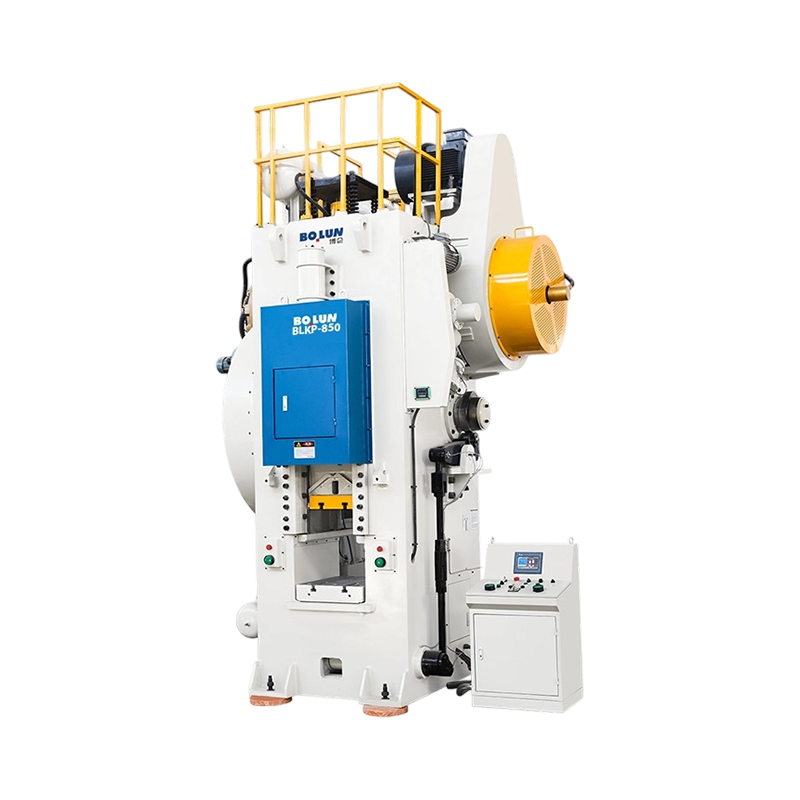
A practical way to ground the discussion is to look at a real product family built specifically for cold forging. Bolun High-Precision Machinery produces the BLKP series of cold forging toggle-type power presses, which covers nominal capacities of 260, 400, 650, and 850 tons. The series is a direct example of the design priorities described above: a toggle drive for high deformation force, a balanced stroke for controlled slide motion, and heavy-duty frame construction for industrial continuous operation.
The BLKP260 is the entry model in the heavy range. It is positioned for upsetting and small-extrusion work, where its agile precision and the stability of the toggle system allow tight dimensional control on high-volume components. Plants producing medium fastener blanks, small bearing races, and electrical connection parts typically start their cold forging line with this capacity.
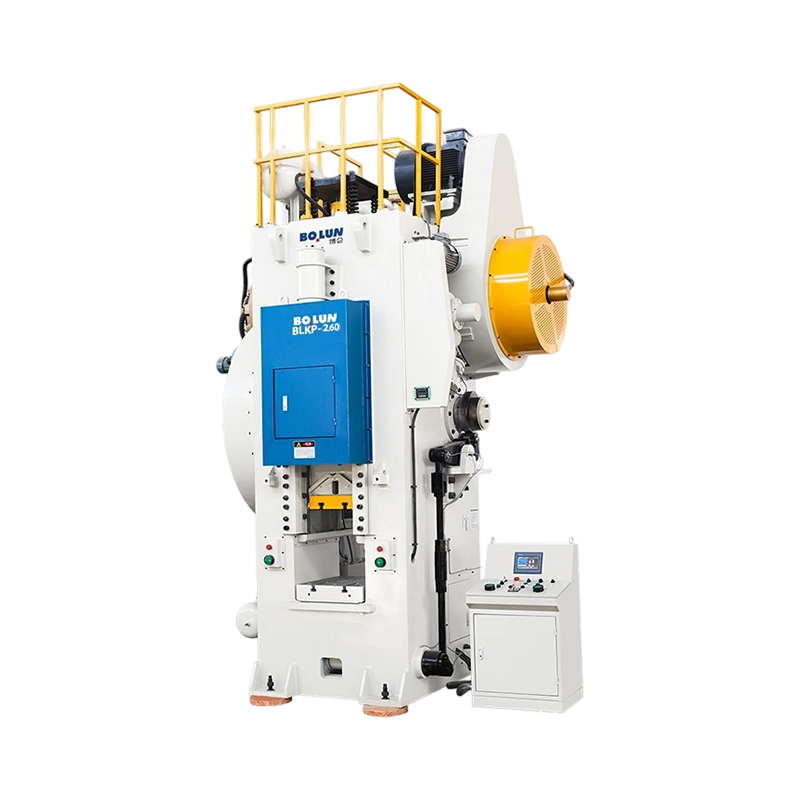 BLKP-260 Agile Precision Cold Forging Toggle PressThis 2600 kN toggle press suits high-speed precision forming of small parts. Its reduced slide speed near bottom dead center supports controlled deformation, ideal for the upsetting and small-extrusion work described here.View Product →
The BLKP400 adds a balanced stroke, which matters when the material has to travel through a longer die cavity: the slide force stays on the part through the full forming zone, so the die fills completely without cracking the corners. It is a common choice for ball studs, tie-rod ends, and automotive brake and steering components.
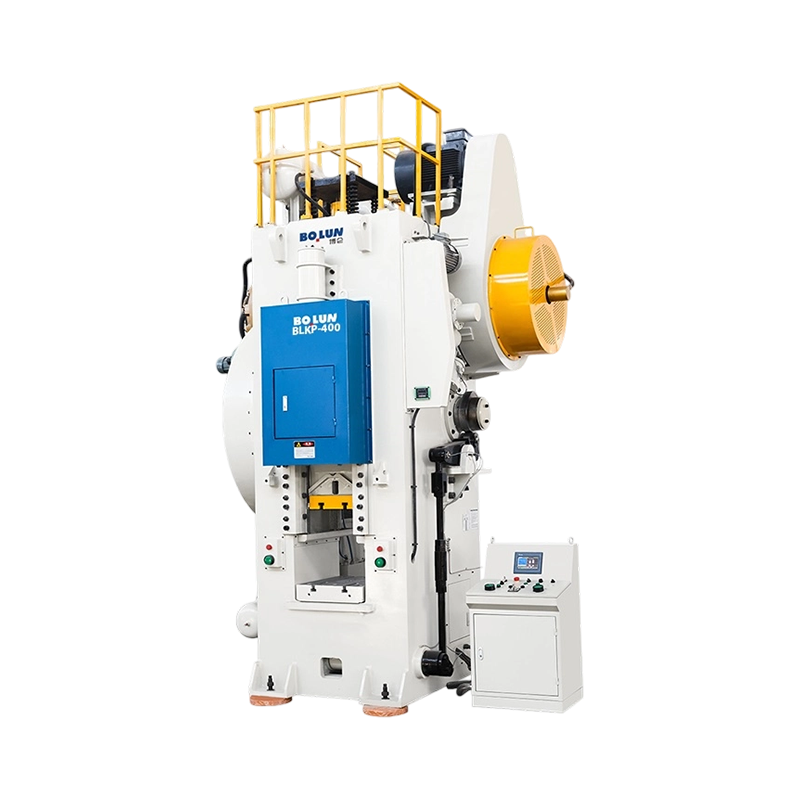 BLKP-400 Balanced-Stroke Cold Forging Toggle PressWith 4000 kN capacity and knuckle-joint mechanism, this model improves material flow for upsetting, coining, and sizing. Its balanced stroke helps fill longer die cavities fully, a key advantage for ball studs and steering components.View Product →
At the upper end, the BLKP650 and BLKP850 are industrial-duty machines for large extrusions, heavy gear blanks, and thick-wall formed parts. The high deformation capability and reinforced frame absorb the repeated load of big cross-sectional reductions at continuous stroke rates. The complete BLKP series is documented on the Bolun product pages, and the sales engineering team can map your specific part to a model after reviewing the drawing.
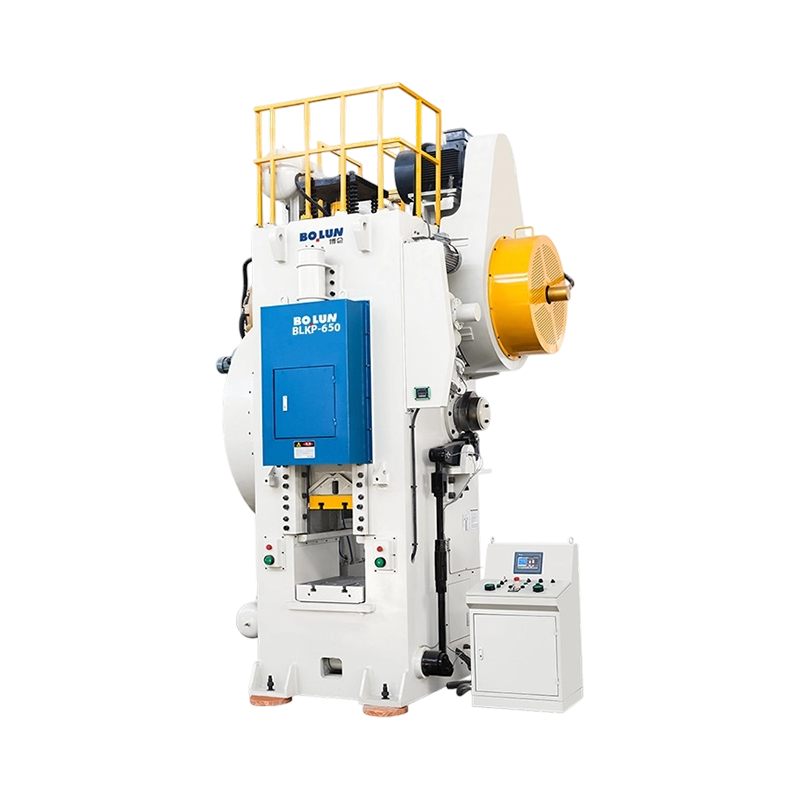 BLKP-650 Heavy-Duty High-Deformation Cold Forging PressThis 6500 kN machine handles heavy compression and deep cold forging with an 8 mm pressure stroke and integrated ejector. Its reinforced frame and load detection safety system suit large extrusions and thick-wall parts in industrial operations.View Product →
Bolun's background supports the claim: the company has produced metal forming equipment for over two decades, operates a full production chain from design and core-component machining to final assembly, and maintains a broad catalog of open-type, closed-type, and special-purpose presses. That full catalog, available on the company website, matters for a buyer because the same factory can supply not only the cold forging press but also the stamping presses and servo presses for the adjacent operations in the same plant.
The cold forming press is not a niche machine; it is the most economical production process for a wide list of components whose shapes are symmetrical, whose volumes are high, and whose materials are sufficiently ductile. The technical core is the toggle mechanism: it puts the tonnage exactly where the forming work happens, protects dies by slowing the slide at contact, and gives the tool designer a predictable force window. The selection process starts with a force estimate, moves to a transparent comparison of tonnage definitions, stroke, stiffness, energy, and guidance, and ends with a partnership with a manufacturer whose frame production and quality system you have verified.
The Bolun BLKP series shows what a modern toggle cold forming press looks like in the 260 to 850 ton range, and the company's broader catalog covers the stamping, servo, and deep-drawing machines that usually surround a cold forming cell. When a part drawing arrives and the volume justifies the process, the most practical next step is to send the drawing and operating conditions to the factory for a cycle-time and tonnage analysis. That is how a press purchase becomes a production decision, and a production decision becomes a competitive cost position.




A production manager at a mid-size metal component plant recently faced a probl...
When you are planning to produce medium or small metal parts in high volumes, t...
A mid-size fastener manufacturer recently faced a familiar problem: its CNC lat...
A cold forging die rarely announces its failure in advance. One day the press r...
Understanding Mechanical Power Presses and Their Essential Functions A mechani...
Power Press Technology Overview: From Fundamentals to Equipment Selection In the...
Contact Us

+86-575-83362228

+86-13735238388

+86-575-83362999

+86-15158259588

Hangzhou Office Add: No. 332 Wangjiang East Road, Shangcheng District

No.1 Linjiang Road East, Xiaren, Jinting Town, Shengzhou City, Zhejiang Province, China
Ready to Begin?
Get in Touch

Now!

ZHEJIANG BOLUN
 English
 中文简体
中文简体
