
A buyer comparing a 45-ton open-gap press for a bracket line often receives two quotes that look nearly identical on paper: same tonnage class, similar bed size, similar price. The difference shows up later—during die setting, off-center piercing, or a deep-draw job that needs force higher in the stroke than the press can deliver. That is why the selection of an open type power press machine should start with the forming operation, not with a catalogue page.
Conclusion first: an open type power press machine is usually the better choice when the job needs fast die access, short changeover, and a moderate tonnage window. A closed-frame press becomes the safer choice when off-center loads, deep drawing, or long-run accuracy dominate. The real decision rests on force at the working stroke, frame deflection, shut height, bed size, and control strategy—not on tonnage alone.
An open type press, often called an open-gap or C-frame press, leaves the front and often the rear and sides open for tooling access. That layout is practical for stamping, piercing, bending, trimming, shallow drawing, and mixed-production work where dies are changed several times a day. The open throat also lets an operator or robot reach the die area more easily than on a closed-frame machine.
The trade-off is stiffness. The frame is essentially a C-shape, so it deflects under load. That does not make it inferior; it makes it suitable for a different job profile. A closed-frame press surrounds the load path with uprights and is generally stiffer, which helps with tight die clearance, heavy off-center loads, and processes that demand consistent ram-to-bed parallelism. The practical comparison looks like this:
| Consideration | Open type press | Closed type press | Practical effect |
|---|---|---|---|
| Die access | Three-sided access is common | Access is limited by uprights | Open type favors frequent changeover and manual feeding |
| Frame stiffness | Lower than a closed frame of similar tonnage | Higher and more symmetrical | Tight clearance and off-center work need more scrutiny on open type |
| Bed and throat | Wide beds are available; throat depth limits part envelope | Large beds and long strokes are common | Large panels may require a deep-throat or closed-frame design |
| Typical work | Piercing, bending, trimming, shallow drawing, battery-shell stamping | Heavy drawing, precision forming, high-tonnage stamping | The tonnage curve and die load profile decide the final match |
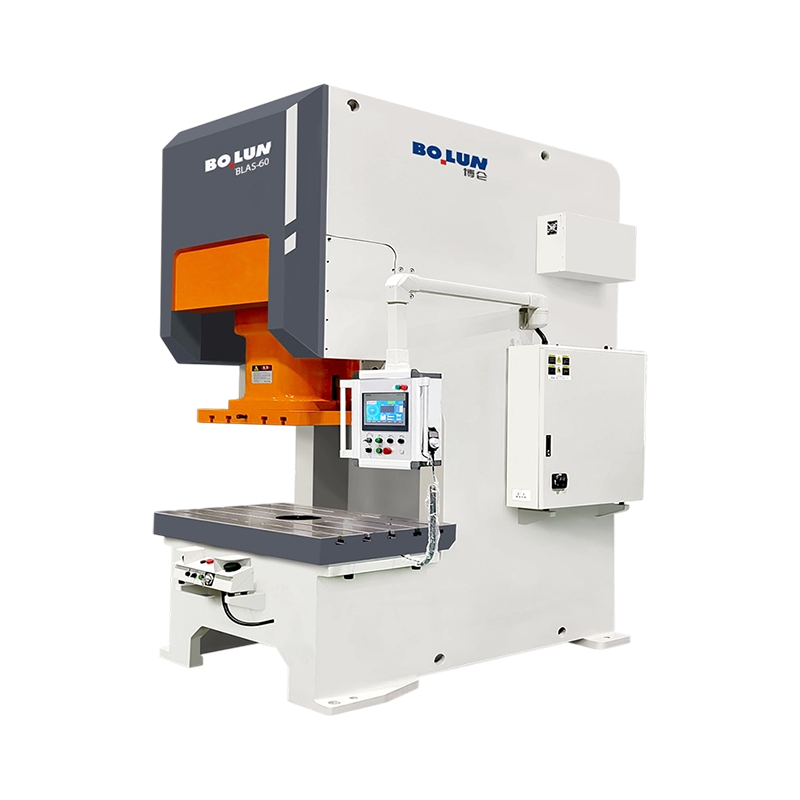
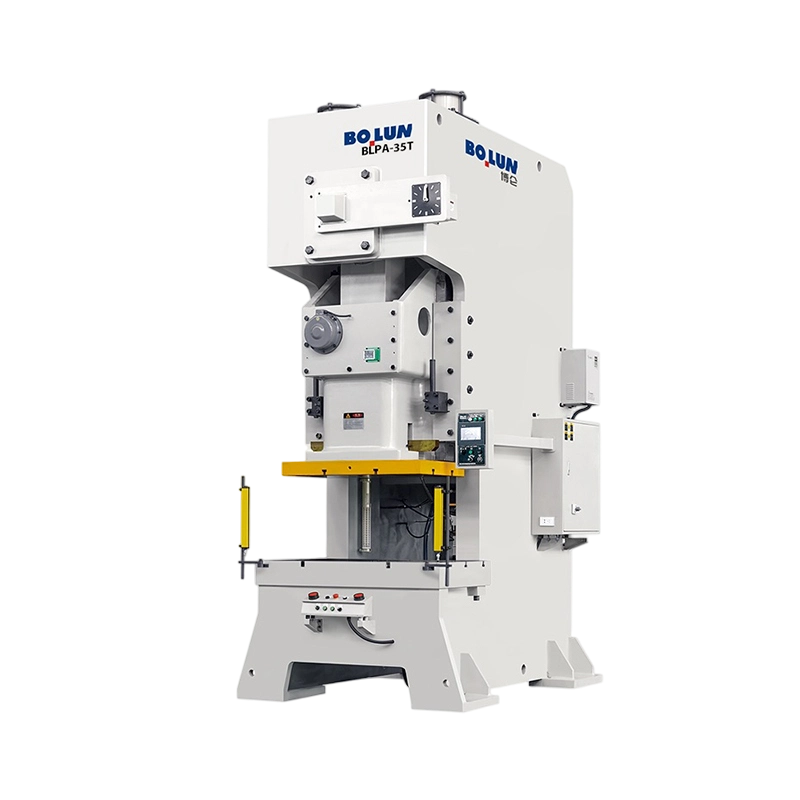
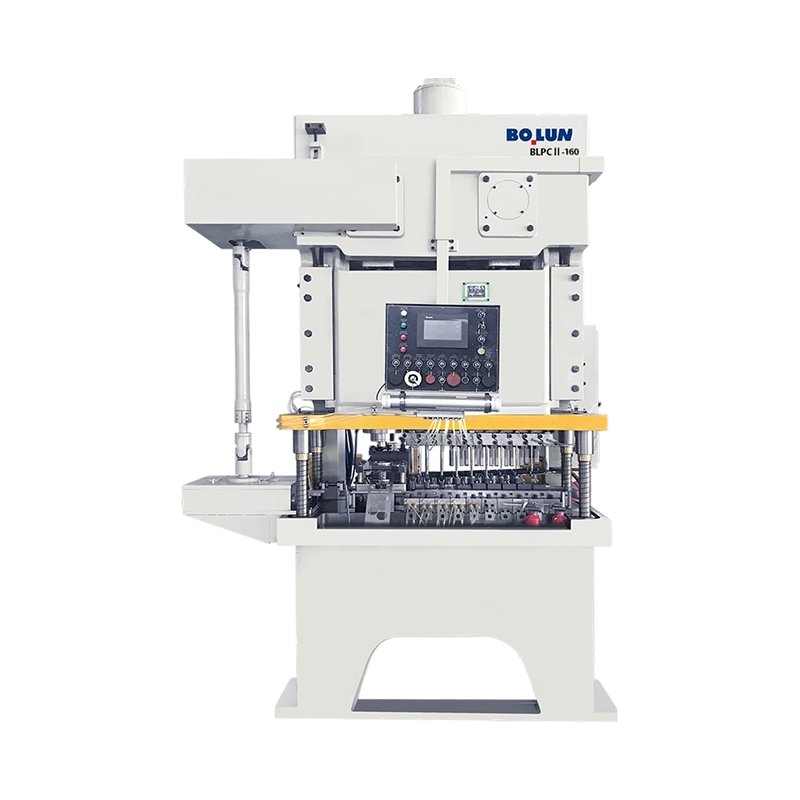
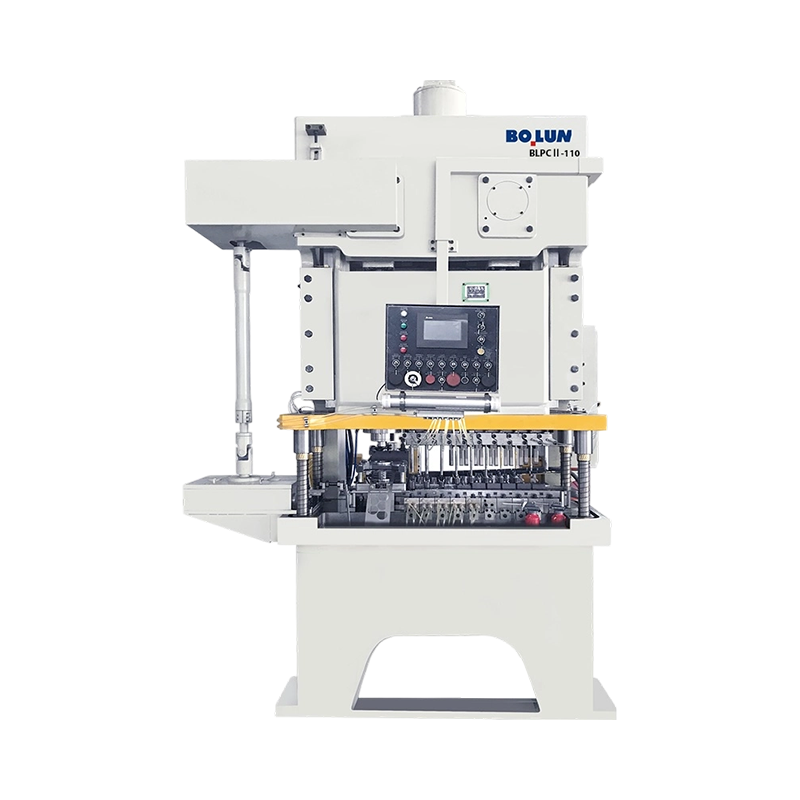
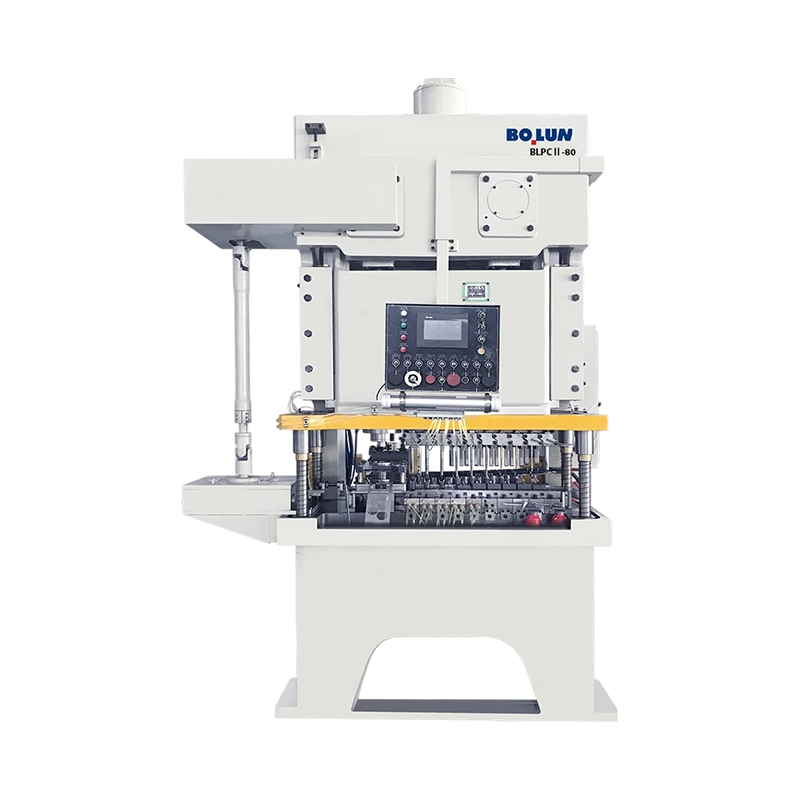
Bolun’s open-type range reflects that logic. It includes single-point BLPA models, double-point BLPC models, deep-throat BLPS models, servo-driven BLAS models, and battery-shell BLPC2 models. The model family matters because a double-point frame, a deep throat, or a servo slide changes the kind of work the press can absorb—not just the price.
Rated tonnage is not a flat number available anywhere in the stroke. On a mechanical press, available force changes through the stroke, and the nominal rating is usually tied to a specified working position above bottom dead center. A die that needs high force early in the stroke may overload a press that looks adequate on nameplate tonnage. That is why a 63-ton press can be safer than an 80-ton press for one job and weaker for another.
For a first estimate, keep the calculated peak forming force below roughly 70–80% of rated capacity, then verify the tonnage curve at the actual working stroke. If a part calculates at 52 tonnes, a 63-tonne frame is not automatically sufficient. The die layout, material thickness, tensile strength, shear area, and draw depth all affect the force profile. For deep drawing, the force may stay high over a longer distance; for blanking, it may peak sharply near the bottom.
Off-center load is the second trap. A press may be rated for 100 tonnes centered, but a die placed far to one side of the ram creates ram tilt, uneven gib loading, and poor die clearance. On an open type press, that effect is more pronounced because the frame itself deflects. Ask for the allowable off-center load and the ram parallelism under load, not just the static bed flatness.
Deflection is not a defect to be eliminated; it is a characteristic to be managed. Under load, the gap in a C-frame tends to close, and the ram may tilt slightly relative to the bed. The result can be uneven punch entry, faster die wear, or burr height that drifts across the strip. For general piercing and bending, a well-built open type press can hold acceptable accuracy. For a die with 0.03–0.05 mm punch-to-die clearance per side, frame deflection and ram guidance matter more than an extra 20 tonnes of nominal capacity.
During procurement, ask for deflection at rated load, ram parallelism over the working stroke, and bed flatness. A supplier who can provide measured data is easier to compare than one who only states “high rigidity.” If the application involves fine blanking, very tight flatness, or a long-run progressive die, a closed-frame design may be the more economical answer because it reduces the amount of accuracy compensation built into the tooling.
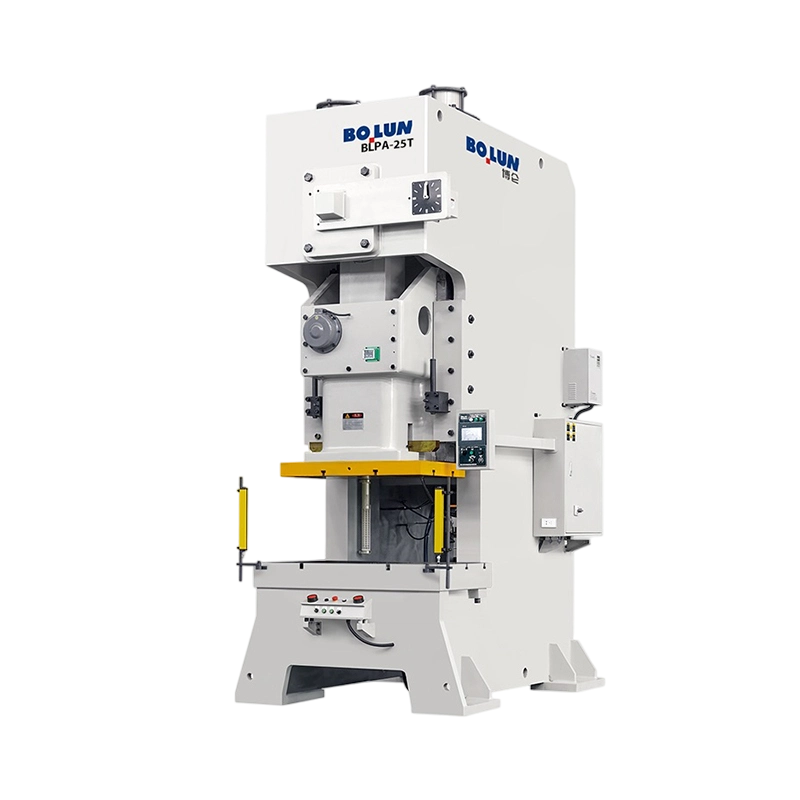
Bolun’s open-type single-point and double-point models use different frame and slide arrangements for this reason. A compact BLPA model suits smaller dies and frequent changeover; a wider BLPC model gives more bed area and two connection points for dies that need better load distribution across the slide.
A press can have enough tonnage and still be unusable because the die will not fit. Check the tooling envelope before comparing price. The useful checklist includes:
A common procurement risk is buying for the part drawing and forgetting the tooling stack. If the die has a thick bolster, a tall guide-pin set, or a pneumatic pad, the required shut height can grow quickly. Adding a spacer may solve the immediate fit, but it can reduce rigidity and change the working height. It is better to confirm the full die stack and the adjustment range before the order.
Most open type presses use a mechanical flywheel drive with a clutch and brake. They are simple, productive, and well understood by maintenance teams. A servo press replaces that fixed slide motion with a programmable curve. The slide can slow at die contact, dwell at the bottom, and return faster. For a deep-drawn cup, that control can improve material flow and reduce wrinkles; for a piercing job, it can reduce shock and noise. The cost is higher, so the process must justify it.
On an open type single-point servo press, the practical benefit is not “more tonnage.” It is control over speed and position through the stroke. That matters when the same machine runs several products and the die tryout team needs to tune the motion rather than change the press.
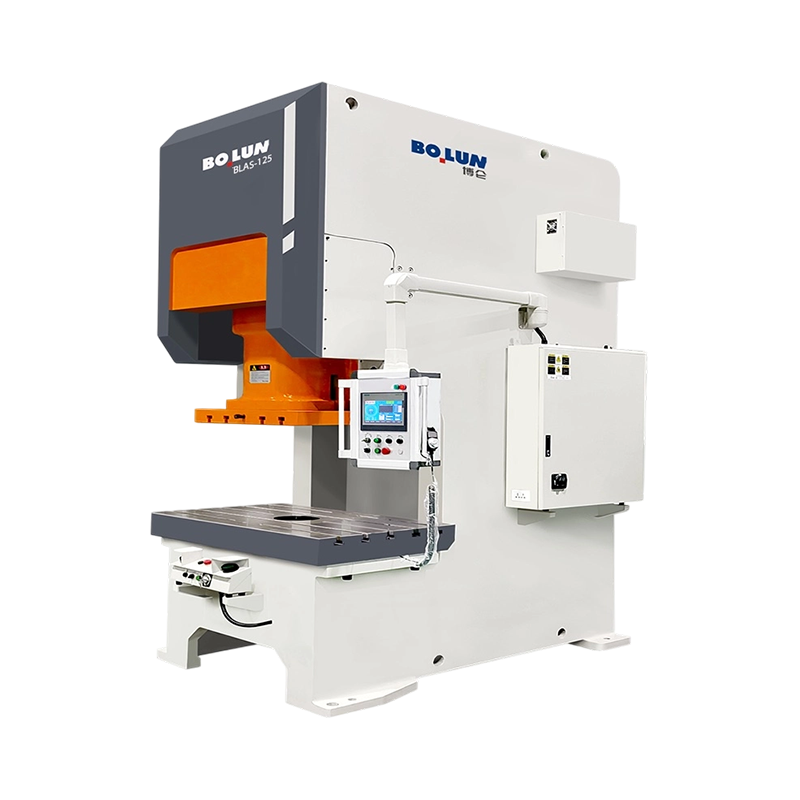 BLAS-125 Open-Type Single-Point Servo Power PressA 1250 kN servo press for deep drawing and stretching, with 350 mm throat depth and 180 mm slide stroke for larger workpieces.View Product →
For wide dies or jobs where the load is spread across a large bed, a double-point open type press can reduce the tendency for the slide to tilt. Bolun’s BLPC200 extra-wide-bed model is an example of that layout: it gives more bed area and two connection points, which is useful when the die is wide but the process still benefits from open-front access.
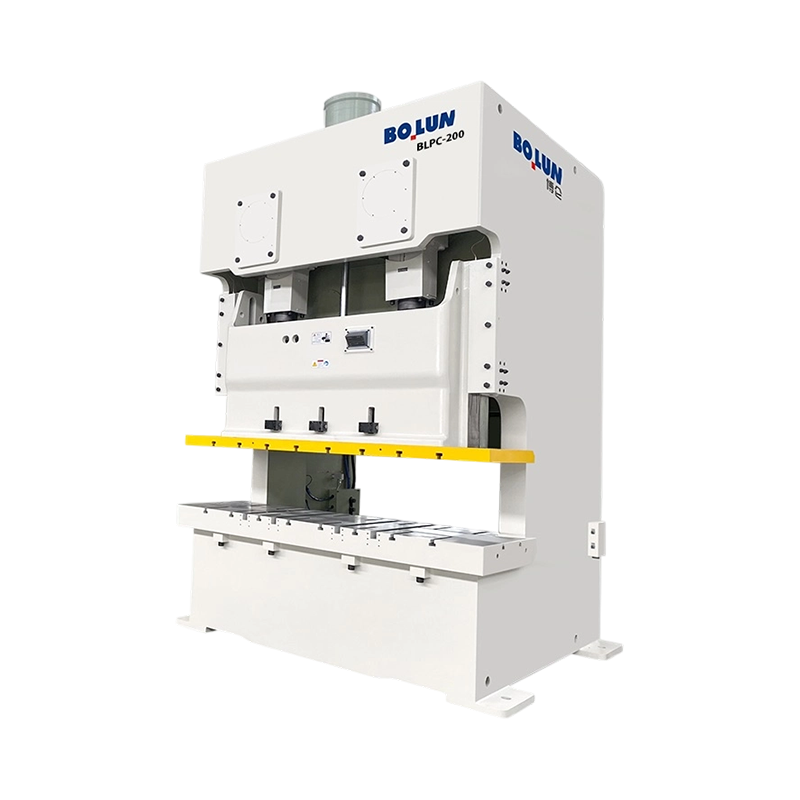 BLPC-200 Extra-Wide Bed Double-Point Open-Type PressA 2000 kN double-point open-type press with a 2400 × 840 mm worktable and 1980 mm between columns for wide dies and large sheet-metal forming.View Product →
Safety is part of the machine specification, not an accessory added after delivery. An open type press needs guarding that prevents access to the point of operation while allowing the die and feed to work. Depending on the market and risk assessment, that may include fixed guards, interlocked movable guards, light curtains, two-hand controls, and lockout/tagout provisions. The electrical and control system should be documented to the relevant standards, such as ISO 12100 for risk assessment and IEC 60204-1 for electrical equipment. In Europe, a CE-marked machine should come with a declaration of conformity and a technical file; in other markets, local requirements still apply.
A common hidden cost is the retrofit. A press that arrives with a CE mark but no risk assessment file, no guard drawings, and no validation record can be expensive to bring into compliance. Ask for the safety concept, stopping performance, guard interlock logic, and spare-part support before shipment. The cheapest quote can become the most expensive machine if production cannot start until the guarding is corrected.
A video of a press running empty is not acceptance evidence. Factory acceptance testing should include no-load running at low and high speeds, lubrication checks, air and electrical checks, and safety function validation. Geometric checks should cover bed flatness, ram parallelism to the bed, and perpendicularity of ram travel. If possible, run the actual die or a representative test die and measure burr height, part flatness, and repeatability.
Site acceptance adds foundation and installation effects. After the foundation has cured and the press is leveled, recheck geometry and run a loaded test. Vibration, noise, temperature rise, and clutch/brake response should be recorded. For a servo press, verify the programmed motion profiles and the stopping performance under production conditions. A machine that meets a static specification but produces unacceptable part scatter after installation is not ready for handover.
The purchase price is only one line in the cost model. Tooling compatibility, die tryout support, spare parts, training, energy use, and downtime all affect the real cost per part. Before signing, ask for the tonnage curve, deflection data, foundation drawing, utility requirements, recommended spare-parts list, and the maintenance schedule. Clarify which components are proprietary and how quickly they can be replaced.
For an open type power press machine used in high-mix production, changeover time can matter more than a small difference in speed. Ask how the die clamping, slide adjustment, and control recipe storage work. For a dedicated line, repeatability and service response may matter more. A supplier with documented test data, a clear safety file, and local service support is usually a better partner than one competing only on tonnage and price.
Bolun’s deep-throat open-gap series shows why application detail matters. A deeper throat can solve a part-envelope problem, but it also changes frame stiffness and floor-space requirements.
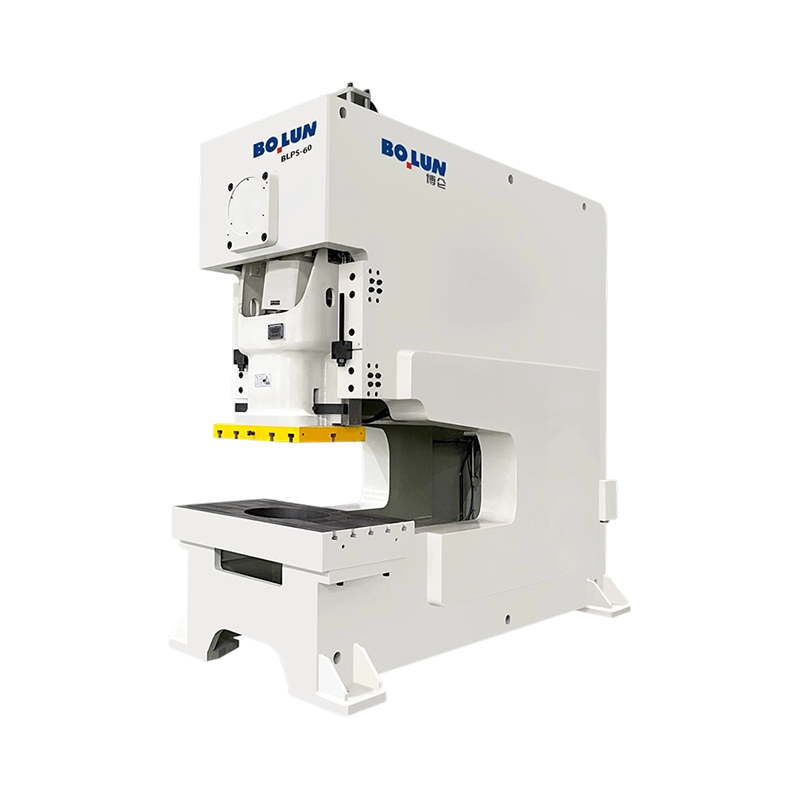 BLPS-60 Open-Gap Deep-Throat Power PressA 600 kN open-gap deep-throat press with 500–1200 mm throat depth and 900 × 520 mm worktable for large-format sheet metal needing extended reach.View Product →
For most general stamping, bending, piercing, and shallow-drawing work, an open type power press machine gives the best balance of access, changeover speed, and cost. It is the practical choice when the die is changed often and the load is reasonably centered. Move to a closed-frame or heavier-duty open type design when the die needs tight clearance, the load is far off-center, the stroke is deep, or the part requires long-run dimensional stability.
The safe buying sequence is straightforward: define the forming force at the working stroke, confirm the die envelope and shut height, check frame deflection and ram guidance, then match the drive and safety package to the production plan. Tonnage is the headline number, but the press that performs well is the one whose frame, bed, stroke, and control system fit the actual job.


Two presses can both carry a 200-tonne nameplate and still produce very differe...
Understanding Mechanical Power Presses and Their Essential Functions A mechani...
A tooling engineer quotes a new bracket program and specifies a 160-ton press. ...
Power press machines are classified in two main ways: by frame construction, w...
A fastener plant in Taizhou receives a request from an automotive tier-one supp...
A mid-size fastener manufacturer recently faced a familiar problem: its CNC lat...
Contact Us

+86-575-83362228

+86-13735238388

+86-575-83362999

8618667502750

Hangzhou Office Add: No. 332 Wangjiang East Road, Shangcheng District

No.1 Linjiang Road East, Xiaren, Jinting Town, Shengzhou City, Zhejiang Province, China
Ready to Begin?
Get in Touch

Now!

ZHEJIANG BOLUN
 English
 中文简体

