
A press is not one machine category. It is a family of metal-forming machines defined by frame, drive, ram connection points, and intended process. That is why two machines with the same tonnage can behave very differently on the same die: one may hold a wide panel flat, another may reach into a deep throat, and a third may deliver a slow, controlled draw without shock. For a buyer, the useful question is not simply “what are the different types of presses?” but “which press type matches the part, die, and production rhythm?”
The short answer: choose mechanical crank or eccentric-gear presses for stable high-volume stamping, servo presses when ram motion must be programmable, toggle presses for cold forging and high-force sizing, and open-frame or closed-frame construction according to part size, bed width, and off-center loading. Hydraulic and pneumatic presses fill other niches. The sections below explain what changes between types and where the specification risk sits.
Most industrial press selection starts with the force-generating principle. The table below gives the working comparison; the rest of the article explains the details that affect die design, footprint, and operating cost.
| Press type | Force principle | Typical fit | Main trade-off |
|---|---|---|---|
| Mechanical crank press | Flywheel and clutch drive a crankshaft with fixed stroke motion | Blanking, piercing, shallow forming, general stamping | Fast and simple, but the stroke profile is fixed |
| Eccentric-gear press | Geared drive and eccentric shaft deliver high torque over a longer stroke | Heavy stamping, deep parts, wide beds, high-tonnage work | More force and rigidity, with greater mass and cost |
| Toggle press | Knuckle linkage multiplies force near the bottom of the stroke | Cold forging, coining, sizing, high-pressure short-stroke work | High mechanical advantage, but not ideal for long draws |
| Servo press | Servo motor controls ram position, speed, and dwell | Deep drawing, multi-step forming, high-strength materials | Flexible motion, with more control complexity |
| Hydraulic press | Hydraulic cylinder provides force with controllable pressure and stroke | Long draws, low-speed forming, pressing operations | Force over long stroke, with slower cycles and fluid maintenance |
| Pneumatic press | Air cylinder provides low-force actuation | Light assembly, marking, small trimming work | Low cost, but limited tonnage and consistency |
The table is deliberately broad. In practice, a mechanical press can be open or closed, single- or double-point, and crank- or eccentric-gear driven. Those combinations matter as much as the drive family. A 160-ton open press and a 160-ton closed press are not interchangeable when the die is wide or the load is off-center.
The frame decides access, rigidity, and how much deflection the die has to tolerate. An open-type press, often called a C-frame, leaves the front and two sides open. That makes manual loading, tool changes, and side access easier. The trade-off is structural: under load the gap can close slightly, so the ram and bed may lose parallelism. For narrow parts, centered dies, and moderate tonnage, that is often acceptable. For wide progressive dies, the deflection becomes a quality and die-life issue.
A closed-type press ties the uprights together at the top, usually with a crown and bed that form a more rigid portal. It handles higher tonnage and wider beds with less angular deflection, which is why it is common for automotive-scale panels, multi-station dies, and heavy stamping. Access is more restricted, so loading automation or side openings need to be planned early. Semi-closed designs sit between the two: more rigidity than a plain C-frame, more access than a full closed frame.
Throat depth is a separate variable. A deep-throat open press lets the operator reach farther into a large panel or work on an asymmetrical part without turning it. But a longer throat is a longer structural span, so the machine must be stiffer for the same rating. Buyers should compare throat depth, bed size, and deflection data together, not treat throat depth as a free bonus. For general open-frame work, an open-type power press is the natural starting point. For a design-level comparison of frame behavior, this open-type versus closed-type press design overview is useful.
Point count refers to how many connection points transfer force from the drive to the slide. A single-point press uses one connecting rod or one central drive point. It is simpler, often more compact, and works well when the die load is centered. A double-point press uses two connection points, usually left and right, so the slide is driven more evenly across its width. The difference shows up in ram tilt, bed deflection, and die wear.
On a wide bed, a single-point machine can still make good parts if the die is centered and the load is balanced. Problems appear with off-center loads, long progressive dies, or stations that do not all cut at the same moment. The slide wants to tilt, the die clearances change side to side, and punch wear becomes uneven. A double-point press spreads the load and reduces that risk. It also tends to suit wide coil-fed work and large panels. The trade-off is cost, greater machine mass, and a larger footprint.
A practical check is the load diagram. Ask where each station sits on the bed and whether the combined load is centered. If the die has a heavy station at one end, a single-point frame may need a larger rating or a different frame; adding tonnage alone does not correct a tilting moment.
The drive determines the force curve through the stroke. A conventional crank press uses a flywheel and clutch to rotate a crankshaft; the slide follows a fixed sinusoidal motion. It is fast, mechanically simple, and well suited to blanking, piercing, and shallow forming where the same stroke profile suits every job. The limitation is flexibility: stroke, speed, and dwell are built into the kinematics.
An eccentric-gear press adds a geared drive and an eccentric shaft to deliver high torque over a longer portion of the stroke. That helps when the forming work is deep or when high tonnage is needed across a wide bed. The machine is heavier and more expensive, but it can hold force farther down the stroke than a simple crank. For high-tonnage, deep-stroke work, this is often the more stable choice than pushing a lighter crank press to its limit.
A servo press replaces the fixed flywheel motion with a servo motor that can program ram position, speed, and dwell. The practical benefit is a motion profile tailored to the part: slow contact to avoid shock, a controlled dwell for coining, or a reverse draw step for difficult shapes. Servo presses are a strong fit for deep drawing, high-strength materials, and multi-step forming where a fixed crank curve causes tearing or wrinkles. They also allow lower idle energy use in some duty cycles, but the control system and maintenance skills required are more advanced. For a stable-bed closed-frame double-point servo platform, the BLES250 is positioned for high-energy, stable-bed work.
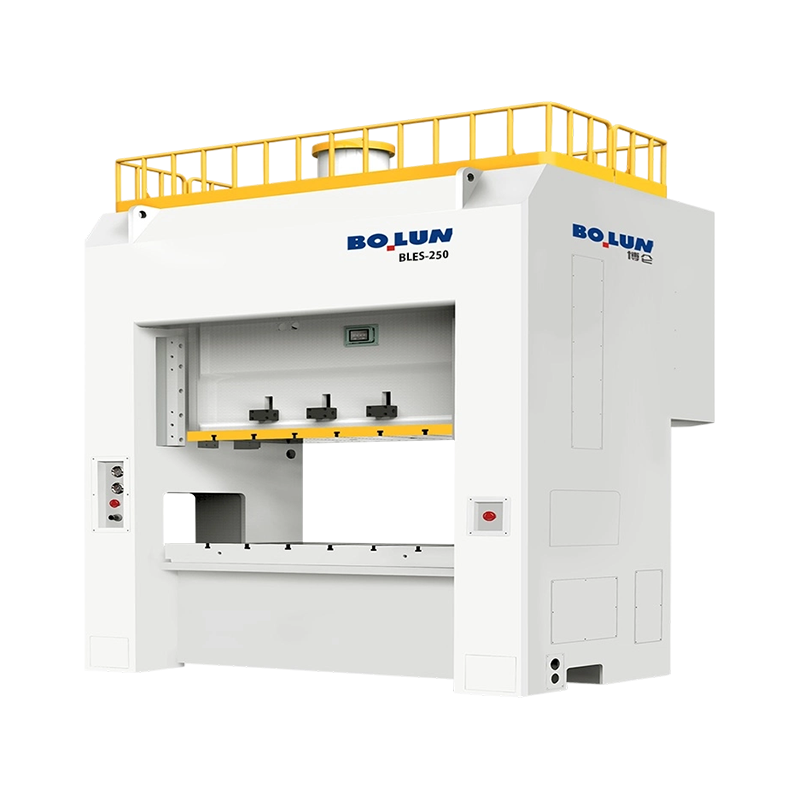 BLES-250 Closed-Frame Double-Point Servo Power PressA 2500 kN servo press for deep drawing and large precision stamping, with closed-frame double-point stability and programmable servo motion.View Product →
A toggle press uses a knuckle linkage to multiply force near the bottom of the stroke. The force curve is steep: high mechanical advantage at the moment of forming, less force earlier in the stroke. That makes toggle presses effective for cold forging, coining, sizing, and other operations that need high pressure over a short distance. They are not the first choice for long draws; the linkage is working against you when stroke length and force need to be constant. For robust high-deformation cold forging, the BLKP650 is a representative toggle-type model.
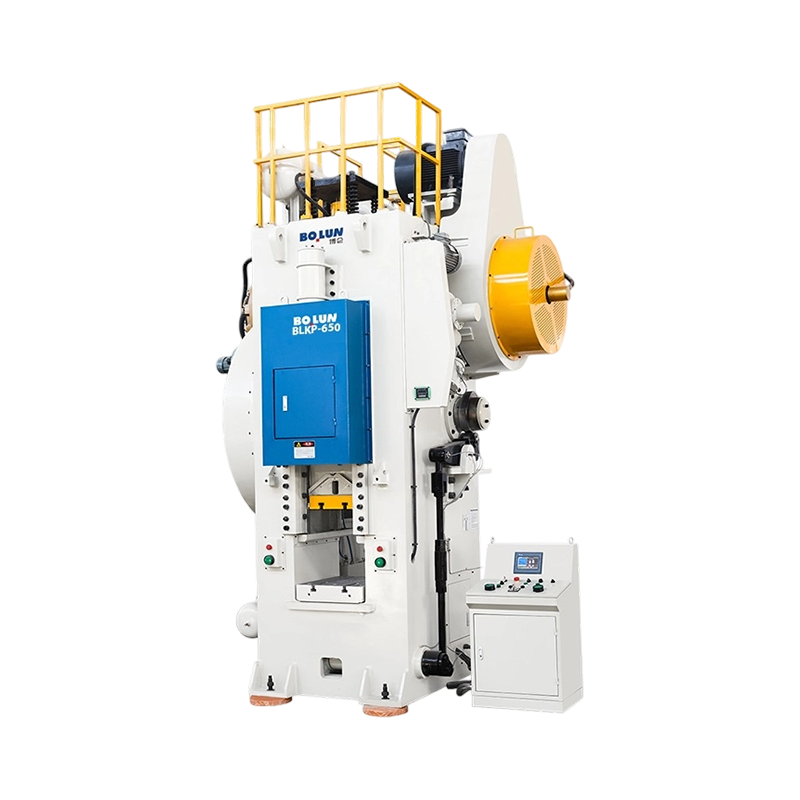 BLKP-650 Toggle-Type Cold Forging Power PressA 6500 kN toggle press for heavy compression and deep cold forging, with a high-rigidity frame and integrated ejector for stable thick-gauge forming.View Product →
The same press category can be right for one part and wrong for another. The following use patterns are a practical filter before the specification sheet.
Battery-shell production combines thin material, high accuracy, and repeatability across many sizes. The press needs a stiff frame, precise slide guidance, and a bed that supports a compact die without excessive deflection. A double-point open press can work here because it spreads load across the shell die and still allows access. For high-tonnage battery shell work, the BLPC2160 is a battery-shell-specific open-type double-point model.
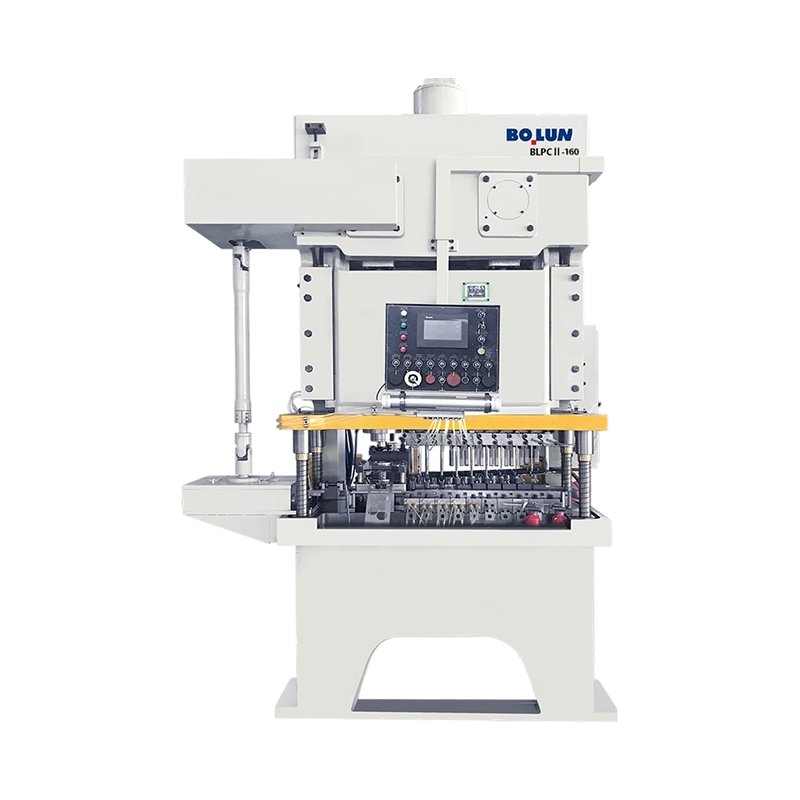 BLPC2-160 Battery Shell Open-Type Double-Point Power PressAn open-type double-point press intended for battery shell production, using balanced load distribution and photoelectric safety for stable forming.View Product →
Deep drawing is less about peak tonnage than about controlling material flow. A fixed crank curve can pull too fast at first contact and then release too quickly. Servo control, die cushion control, and consistent lubrication matter more. A servo press with programmable dwell and reverse draw can reduce trial-and-error in the die. The same logic applies to high-strength steel and aluminum alloys that are sensitive to forming speed.
When the part is wider than the die window or the coil runs across a long bed, frame rigidity and double-point load distribution become the main issues. Closed-frame presses with wide beds and eccentric-gear drives are the usual route for large panels, appliance skins, and structural stampings. The buyer should ask for bed deflection limits, ram parallelism, and the load curve at the actual working angle, not just the nominal tonnage at bottom dead center.
Cold forging is a different process from sheet stamping. The billet flows in three dimensions, the tooling sees high pressure, and the press must deliver force near the bottom of the stroke without excessive elastic recovery. Toggle and heavy-duty crank presses are common. Tooling guidance, ejector systems, and frame stiffness deserve as much attention as tonnage. A press rated for stamping may not have the guiding stiffness or energy capacity for a forging die.
A press quote is only useful when it is tied to a process. Before comparing offers, put these items on one sheet:
A supplier that asks for the part drawing, die layout, and production target is easier to trust than one that quotes only a tonnage number. The part and die define the press; the press does not define the part.
The different types of presses are easiest to understand as a chain of decisions: force principle, frame, point count, drive, and application. A mechanical crank press is the general-purpose workhorse; an eccentric-gear press adds torque and reach for heavy work; a servo press trades mechanical simplicity for motion control; a toggle press converts linkage into high force near the bottom; and open, closed, and semi-closed frames set the access and rigidity envelope. Hydraulic and pneumatic presses remain valid for other force and cycle requirements. The right choice is the combination that keeps die load centered, matches the stroke curve to the material, and leaves enough stiffness for the tolerance you intend to hold.
Manufacturing & Metalworking A direct, practical look at how mechanical pre...
Power press machines are classified in two main ways: by frame construction, w...
As the manufacturing industry moves steadily toward automation and smart product...
Understanding Mechanical Power Presses and Their Essential Functions A mechani...
Put a 160-ton open-frame press and a 160-ton closed-frame press side by side an...
In modern manufacturing, cold forging is widely used in the automotive, aerospac...
Contact Us

+86-575-83362228

+86-13735238388
+8618667502750

+86-575-83362999

+8618667502750

Hangzhou Office Add: No. 332 Wangjiang East Road, Shangcheng District

No.1 Linjiang Road East, Xiaren, Jinting Town, Shengzhou City, Zhejiang Province, China
Ready to Begin?
Get in Touch

Now!

ZHEJIANG BOLUN
 English
 中文简体

