
Two 160-ton presses can stand side by side on the same shop floor, share the same electrical supply, cost roughly the same per unit, and still deliver completely different part quality. The difference is usually not tonnage and not the control panel. It is the frame. A closed type power press machine carries the forming load through a closed structural loop, from the bed up through two or four uprights into the crown and back down through the slide. An open-type press carries the same load through a C-shaped throat that has to spring open and spring back on every stroke. That single geometric fact drives die life, part tolerance, allowable off-center loading, foundation requirements and, ultimately, how much of your day is spent adjusting rather than producing.
The short answer before the long one: if your die is wide, your part tolerance is tight, your stroke count per die design is high, or your tooling is a progressive or transfer die, a closed-frame machine is the correct baseline. If you need three-sided access for awkward blanks, low volume and short runs, or a very small die set, an open frame will do the job for less money and less floor space. Everything else is detail, and the detail is where machines get bought badly.
A closed-type power press, often described in English-language catalogs as a straight-side press, uses a frame in which the load-bearing structure forms a closed rectangle or box around the die space. The bed sits at the bottom, the slide runs between uprights that rise from bed level, and the crown ties the uprights together at the top. The crank, eccentric gear shaft, flywheel, clutch and brake assembly live in that crown, and the pitman or pitmans transfer motion down to the slide. Because the structure is closed, the forming force has a continuous path to follow and does not have to be resisted by a frame that is open on one side.
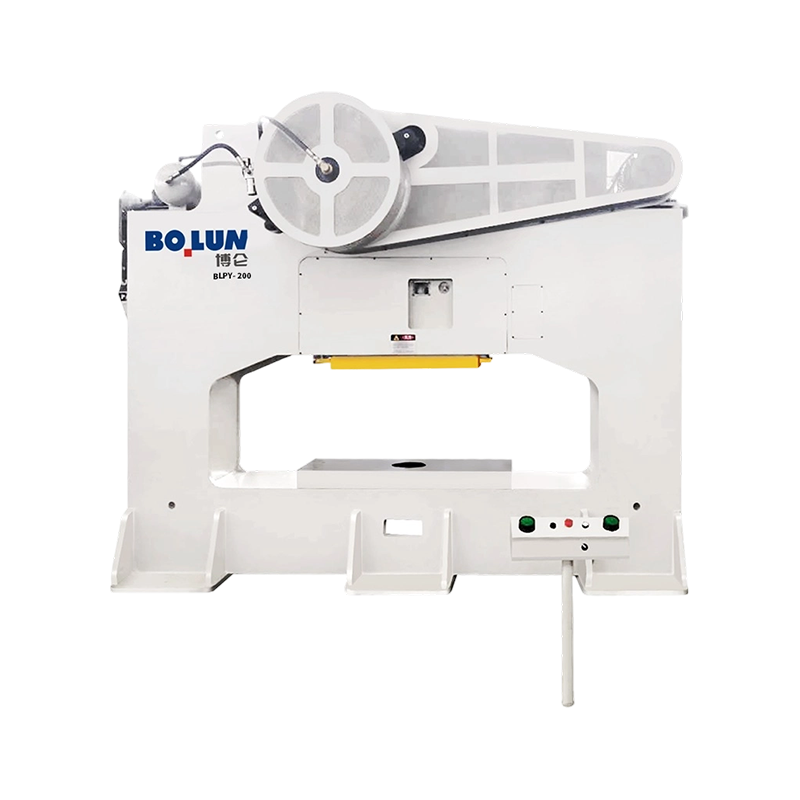
This is not an abstract difference. On an open-type machine, the throat depth acts like a lever arm. The further the load sits from the frame's back, the more the frame deflects and the more the slide tilts. Deflection is recoverable, so nothing breaks, but it does change the shut height during the working part of the stroke. If the die was set to a clearance of 0.08 mm, and the frame and slide move by 0.15 mm under load, the clearance is no longer what the tool designer intended. A closed frame does not eliminate deflection, because no structure is infinitely stiff, but it reduces both the magnitude and, more importantly, the angular component that tilts the slide relative to the bed.
Three features do most of the work. First, the uprights are loaded in tension along their long axis rather than bent, which is the most efficient way to carry a load in steel or cast iron. Second, the crown and bed are deep box or ribbed sections that resist bending over the span between uprights. Third, tie rods or a welded or cast monoblock construction preload the structure so that joints do not open and close cyclically. On larger machines, tie rods are heat-shrunk or hydraulically tensioned to a defined preload, and that preload is one of the things a buyer should ask about, because a press that has been dismantled and reassembled without restoring tie-rod tension will not behave like the machine that was tested at the factory.
Slide guiding matters as much as the frame. Closed-frame presses typically use two, four or eight gib points, with the slide guided against the uprights or against separate guide rails. Some designs add a hydraulic or mechanical slide balance cylinder to take the weight of the slide and die, which reduces the load on the gibs and keeps the slide level when the die is heavy. A press with a stiff frame and loose gibs is a stiff frame that produces inconsistent parts.
A useful mental model is to think of the open frame as a bent bracket and the closed frame as a picture frame. Apply a force to the middle of the bottom member of each and observe what happens to the top member. In the bracket, the whole shape rotates. In the picture frame, the side members stretch slightly and the top member stays parallel to the bottom. That parallelism is what protects die clearance and punch-to-die alignment. It is also why closed-frame presses tolerate higher tonnage per unit of frame weight and can run progressive dies with many stations spread across a wide bed. If you want a longer comparison of the two architectures, there is a useful overview in this open-type versus closed-type power press comparison.
"Closed type" describes the frame. It says nothing about how the slide is driven or how many points suspend it. Buyers who stop at the frame description end up comparing machines that are not really comparable. The closed-frame category splits along two axes: how many connection points link the slide to the drive, and what kind of drive transmits the energy.
A single-point press has one pitman connecting the crank or eccentric to the slide, usually on the centerline. The slide is then guided and balanced by the frame and gibs. Single-point closed-frame machines, especially wide-door variants, are popular for single-station dies, shallow forming, and jobs where the operator needs generous access to the die area from the front. The trade-off is that an off-center load produces a tilting moment on the slide, so the die should be positioned close to the centerline and the tonnage should be distributed evenly.
A double-point press uses two pitmans, spaced left and right, to drive the slide. This distributes the driving force across the width of the slide and dramatically improves resistance to off-center loading. Double-point closed-frame presses are the standard choice for progressive dies, transfer tooling, and any application where the working stations are spread across a wide bed. The cost premium over single-point is real, but it is small compared with the cost of a progressive die that cannot hold tolerance because the slide rocks.
On a crank-driven press, the crank radius defines the stroke and the crankpin carries the full load. As tonnage rises and stroke lengthens, the crankpin and connecting rod grow quickly, and the machine becomes tall and heavy. An eccentric gear drive places the crankpin inside a large gear that is itself eccentric, so the same stroke is generated with a shorter crank throw and a shorter connecting rod. The result is a more compact machine for the same tonnage and stroke, better torque distribution through the gear train, and, in most implementations, a slower slide velocity near bottom dead center, which is exactly where drawing and coining need it.
The practical value shows up in deep drawing, cold forming of thicker stock, and heavy plate work. A machine in the 400 to 800 ton band with a long stroke and an eccentric gear drive can carry a tall die and still keep the crown at a manageable height. Learn more about capability at this tonnage level on the eccentric gear closed-type press range, where stroke length, bed area and gear ratio are the three numbers worth comparing first.
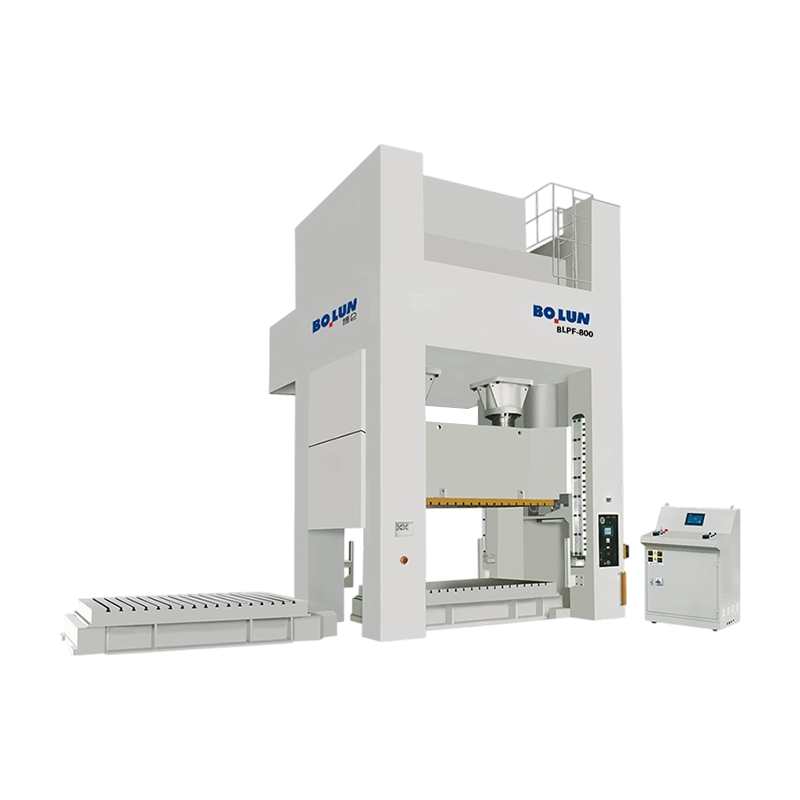
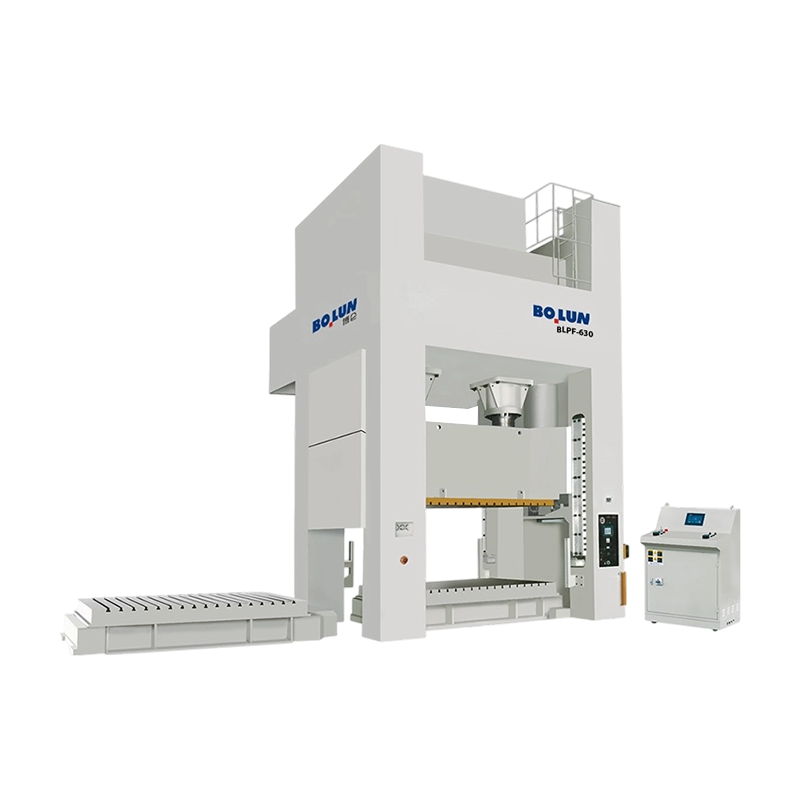 BLPF-630 Deep-Stroke Closed-Type Double-Point Eccentric Gear Press630-ton press with 400 mm stroke, 800 mm die height and double-point slide, suited to tall deep-drawing dies and heavy forming.View Product →
A machine such as the BLPF630 sits in the middle of that family: 630 tons of rated capacity, a deep stroke intended for tall drawing dies, and a double-point slide on a wide bed. It is the kind of press a supplier specifies when the part is a drawn enclosure rather than a flat bracket, and when the die stack is deep enough that die height, not tonnage, becomes the limiting dimension.
A servo press replaces the flywheel, clutch and brake with a servomotor and a screw or crank mechanism, giving programmable slide motion. The slide can approach fast, decelerate to a controlled forming speed, dwell at the bottom, reverse before bottom dead center, or oscillate. For high-strength steel and aluminum alloys that spring back and work-harden, this control over the velocity profile reduces cracking and improves dimensional consistency. It also cuts noise on blanking because the slide does not have to travel at full crank speed through the material.
The trade-offs are higher capital cost, more control electronics to maintain, and the need for a programmer who understands motion profiles rather than just stroke and SPM. A servo closed-frame machine is not automatically better than a mechanical one, but for a part family with several geometry variants and a die that needs different forming speeds at different stations, it often pays back within two or three tooling generations. A representative example in the 250-ton class is the BLES250, which uses a stable bed and high available energy to combine drawing and blanking duty in one machine.
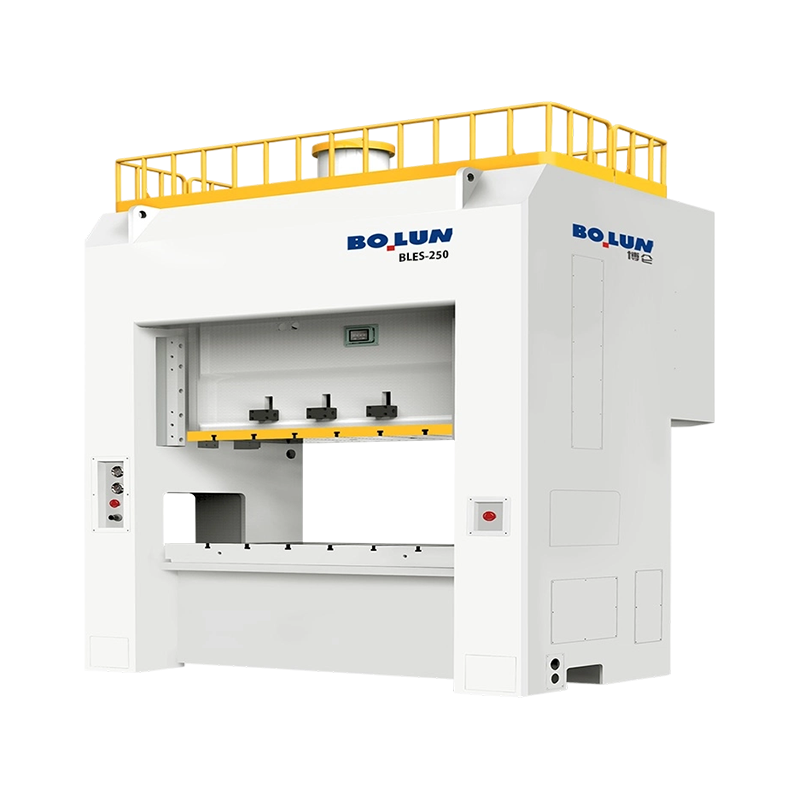 BLES-250 High-Energy Closed-Frame Double-Point Servo Press250-ton servo press with 25,200 J working energy, 280 mm stroke and CNC control, combining drawing and blanking duty in one frame.View Product →
The table below is a starting point, not a specification. Tonnage bands shift with builder and model, and the right answer always depends on the die, the material and the tolerance.
| Configuration | Slide suspension | Typical tonnage band | Best suited to | Main trade-off |
|---|---|---|---|---|
| Closed single-point, wide door | One pitman, centerline drive | 110 to 200 t | Single-station dies, shallow forming, jobs needing generous front access | Slide tilts under off-center load, so keep the die centered |
| Closed double-point | Two pitmans, left and right | 160 to 315 t | Progressive and transfer dies, wide beds, multi-station work | Higher price and less efficient on small dies |
| Closed double-point eccentric gear | Two pitmans, gear-driven eccentric | 400 to 800 t | Deep drawing, heavy plate, long strokes, tall die stacks | Tall and heavy, needs a substantial isolated foundation |
| Closed-frame double-point servo | Two pitmans, servomotor drive | 160 to 315 t | High-strength steel, programmable forming, quiet blanking | Higher capital cost and more control expertise required |
| Semi-closed single-point | One pitman, side plates on an open frame | 110 to 260 t | Mixed work needing access plus better stiffness than an open frame | Sits between two architectures and matches neither exactly |
Most bad press purchases start with a tonnage figure copied from a part drawing and end with a machine that is either too small for the die or far larger than the work requires. Rated tonnage is only meaningful in combination with three other numbers: where in the stroke that tonnage is available, how large the bed is, and how much die height the frame can accept.
Nominal capacity is normally quoted at a defined point just above bottom dead center, often a few millimeters up. That matters because forming forces peak near the bottom of the stroke for most operations, but not all. Coining, sizing and cold forging can demand high force very close to bottom dead center, while deep drawing demands a more sustained force through a longer portion of the stroke. A 200-ton press does not deliver 200 tons at every point in the stroke; the capacity curve falls off as the slide rises.
Ask for the capacity curve, not just the headline number. Then check the allowable off-center load. Every closed-frame press has a limit on how far from the centerline the working force can sit, and that limit is expressed as a permissible eccentric load or a permissible tilting moment. A progressive die with seven stations spread across a 2,000 mm bed can easily violate that limit even when total tonnage is well within rating. If the machine has a tonnage monitor with individual strain-gauge readings on each upright, you can see the imbalance in real time rather than discovering it through a cracked die section.
Bed size is the left-to-right and front-to-back dimension of the bolster surface. What actually constrains the die is often the window: the clear distance between the uprights and the front-to-back opening through which the die and the part must pass. A die can be as large as the bed, but if it cannot pass through the window during loading, it will not go in. Check three dimensions together: bed, window, and the height available under the slide at the top of the adjustment range.
For progressive dies, also confirm the available space for a scrap chute, a die cushion, and any nitrogen spring or hydraulic manifold that hangs below the die shoe. Many presses lose 100 mm or more of useful die height to hardware that no one accounted for during quotation.
Stroke is the total travel of the slide. Die height, sometimes called shut height, is the vertical space between the top of the bed and the bottom of the slide at bottom dead center with the adjustment in a specified position. Die height, not stroke, is the number that decides whether a tall drawing die fits. Stroke decides whether the part can be extracted and whether the transfer mechanism has room to move.
A long stroke is not free. It increases the reciprocating mass, lowers the achievable stroke rate, and increases the machine's overall height. On a deep drawing job, a stroke that is longer than necessary simply wastes energy accelerating a slide that has nothing to do for part of the cycle. Size the stroke to the part depth plus a working margin for the stripper and the transfer, typically 30 to 60 percent more than the draw depth depending on the tooling.
Strokes per minute tells you the maximum cycle rate, not the productive rate. The productive rate comes from energy per stroke, slide velocity at contact, and how quickly the part handling can keep up. For blanking, higher contact velocity generally means better edge quality on some materials and more noise on all of them. For drawing, lower contact velocity means less risk of rupture.
Motor power and flywheel energy determine whether the press can sustain the rated tonnage continuously or only in short bursts. A flywheel-driven press recovers energy between strokes, which is why a 200-ton machine can do heavy coining at 40 strokes per minute but not at 90. If your production plan assumes continuous running near rated capacity, verify the continuous energy rating rather than the peak figure.
Closed-frame machines cost more than open-frame machines of the same tonnage, take longer to install, and require more floor space and a heavier foundation. They pay that back in specific kinds of work.
A progressive die concentrates many operations across the bed width, and every station loads the slide at a different point. On a double-point closed frame, both pitmans share the load and the slide stays parallel to the bed, so the punch-to-die clearance at station seven is the same as at station one. On an open frame, the two ends of the bed deflect differently and the cumulative error shows up as burr variation across the strip width.
Transfer presses have the same requirement plus an additional one: the transfer mechanism needs a stable reference. If the frame moves under load, the transfer fingers move relative to the die and timing becomes unreliable. That is a large part of why transfer work is almost exclusively a closed-frame application.
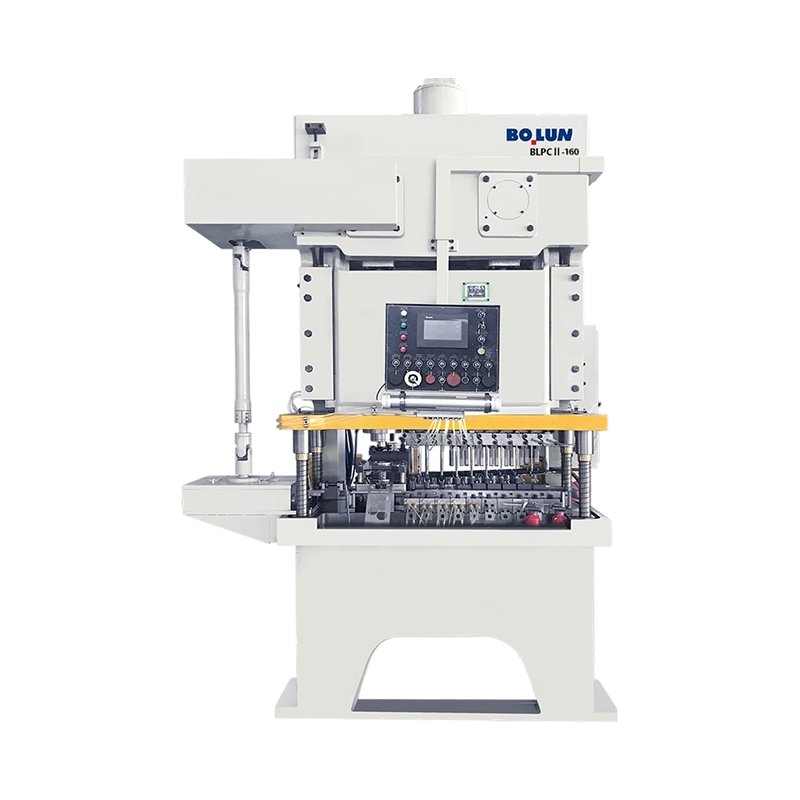
Deep drawing is a process where the punch travels a long distance through the material under a sustained load. The die cushion that controls blank holder force also pushes back against the frame. On a closed frame, the cushion load and the forming load share a common structural loop, so blank holder force stays more consistent through the stroke. The result is fewer wrinkles, fewer splits, and a more stable draw ratio. Wide-bed double-point machines in the 200 to 315 ton range handle a large share of this work in appliance, automotive and enclosure manufacturing. A machine like the BLPE250, with a robust wide bed and double-point slide, is a typical specification for mid-size drawn panels.
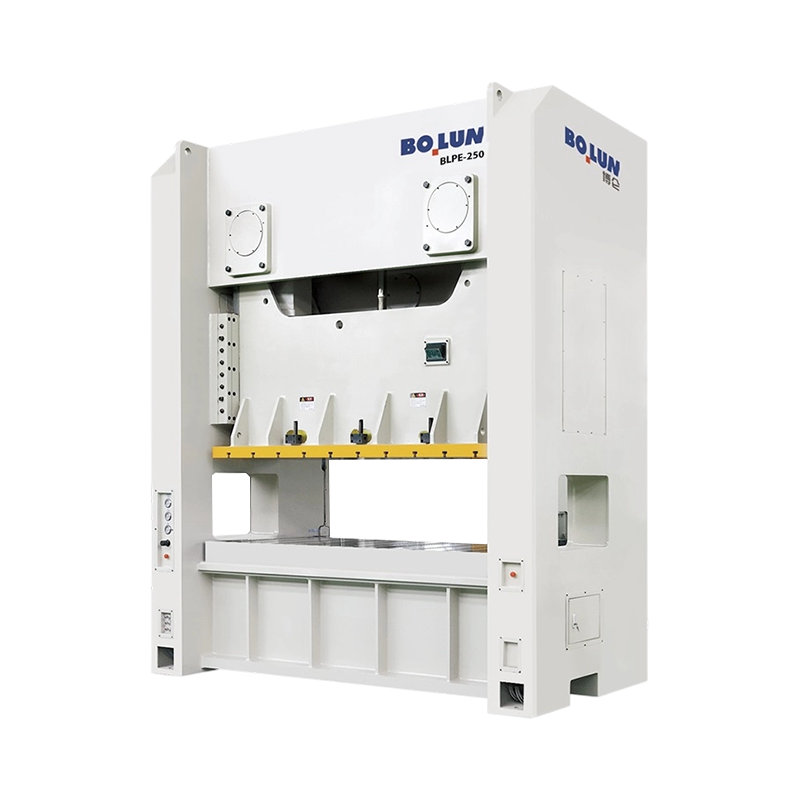 BLPE-250 Wide-Bed Closed-Type Double-Point Press250-ton wide-bed press with 2800 mm column distance and 605 mm die height, built for large progressive dies and mid-size drawn panels.View Product →
Thin-gauge precision blanking demands small, consistent clearances and minimal punch penetration variation. On a frame that deflects significantly under load, the effective clearance varies from the start of the stroke to the bottom, and burr height varies with it. Closed-frame presses hold clearance more consistently, which lengthens die maintenance intervals and reduces secondary deburring cost. Where the material is high-strength steel or where a shaved edge is required, the difference is not marginal.
Not every stamping job needs a closed frame, and buying one when the work does not require it ties up capital and floor space for no return. Consider an open or semi-closed machine when most of the following are true:
Semi-closed machines sit deliberately between the two architectures. They add side plates to a C-frame to recover part of the stiffness while keeping much of the access. They are a reasonable compromise for mixed job shops, but a compromise is what they are. If more than about half the workload is progressive or precision work, the semi-closed machine will become the bottleneck.
Buyers who start with tonnage tend to overbuy. Buyers who start with the die tend to get it right. A defensible sequence looks like this.
Step three is where most specifications fail. It is easy to state total tonnage and forget that a wide progressive die loads the slide asymmetrically. If the machine's tonnage monitor cannot show per-upright strain, ask the builder to supply the permissible eccentric load table and check it against the projected load map.
Buyers often ask for a parallelism figure and assume it describes the machine in production. It does not. Geometric accuracy is normally measured statically, with the machine unloaded or lightly loaded, at a controlled temperature. Working accuracy includes frame deflection, slide tilting, thermal growth from the clutch and lubrication system, and the elastic behavior of the die itself.
A general-purpose straight-side press may show total frame deflection on the order of a few tenths of a millimeter at rated load, spread across vertical compression and angular tilt. Precision-class machines hold tighter figures, and builders who target precision blanking or thin-gauge forming will quote deflection per unit of shut height so that the number can be scaled to the actual machine. When comparing quotes, ask for the basis: at what percentage of rated tonnage, at what point in the stroke, and whether the figure includes slide and bolster compression.
Thermal effects deserve more attention than they usually get. A press that has been idle overnight will not hold the same dimensions at 10:00 as it did at 06:00. Machines running near rated capacity for hours warm the lubrication oil, the clutch and the frame, and the shut height drifts. If the part tolerance is under 0.05 mm, plan a warm-up routine, a shut height check at defined intervals, and, on higher-end machines, a closed-loop slide adjustment that compensates automatically.
A closed-frame press concentrates a great deal of energy in a small space, and the safety package is not the place to accept a generic specification. At minimum, expect two-hand control with anti-tie-down logic for manual feed, light curtains or laser scanning with muting for automatic feed, a slide lock or safety block for die maintenance, and lockout provisions for the main drive and the flywheel where one is fitted.
Jurisdiction determines the standard. In the United States, mechanical power presses fall under OSHA 1910.217, which sets requirements for guarding, control reliability, brake monitoring and periodic inspection. In Europe, EN 692 and the ISO 16092 series apply, and the machine needs a CE marking with a documented risk assessment. Other markets have their own regimes, and a machine built for one market may not satisfy another without modification. Confirm the applicable standard in the purchase order, not after delivery.
Controls have moved a long way from relay logic. Modern closed-frame presses ship with PLC or dedicated press controllers, recipe management, tonnage monitoring, die identification, and networked production counters. The practical question is not whether the controller has these functions but whether your maintenance team can service it and whether the builder will supply schematics, parameter backups and a spare parts list at handover. A press with excellent mechanics and an undocumented controller becomes a bottleneck the first time a card fails.
A closed-frame press is heavier than an open-frame machine of the same tonnage and concentrates that mass differently. Most installations call for a separate foundation block, isolated from the surrounding slab, sized to distribute the dynamic load and to keep vibration out of adjacent precision equipment. The block mass is usually specified as a multiple of the machine mass, and the multiple depends on the tonnage, the stroke rate and the nature of the work. High-speed blanking needs more isolation than slow drawing.
Check the following before the machine arrives:
Installation sequencing matters as much as the foundation. A press that is leveled before the die cushion and feed equipment are mounted may need re-leveling afterward. Allow time in the project plan for a second leveling pass and a geometric check once all ancillary equipment is in place.
The maintenance profile of a closed-frame press is predictable, which is good news for planning. The highest-wear items are the clutch and brake friction surfaces, the slide gibs, the pitman bearings, the lubrication system and the overload protection device. Everything else tends to fail either early, during the first few hundred hours, or after a long service life.
Build a schedule around four tiers. Daily checks cover lubrication level and flow, air pressure, abnormal noise, and safety device function. Weekly checks cover gib clearance, slide balance pressure, and tonnage monitor calibration verification. Quarterly checks cover clutch and brake wear measurement, flywheel brake function, and electrical terminal tightness. Annual work includes oil analysis, hydraulic and pneumatic seal inspection, tie rod preload verification where applicable, and a full geometric accuracy check.
Two design details make maintenance easier and are worth specifying. First, a hydraulic overload protection system that releases at a set tonnage and resets without dismantling the machine protects both press and die from a mis-set shut height. Second, centralized or automatic lubrication with fault detection prevents the most common cause of premature gib and bearing wear. Both are inexpensive at the point of order and expensive to retrofit.
Most disputes between press buyers and builders come down to documents rather than hardware. The machine is usually fine; the paperwork is what was assumed rather than stated. The following items belong in the purchase order.
Witness testing at the builder's plant is worth the travel. Ask for a geometric accuracy report, a no-load run test at maximum stroke rate for a defined period, a load test at a stated percentage of rated tonnage, a safety device functional test, and a clutch and brake stopping performance measurement. Photograph the test setup and keep the records with the machine documentation. If a load test is not practical, ask for the deflection measurement under a known load and the method used.
Agree on a first-parts package that at minimum covers clutch and brake friction elements, seals for the overload system, a set of gibs, lubrication filters, and any proprietary controller module that has a long lead time. Require electrical schematics in editable format, a full parameter backup, an operation and maintenance manual in the language of the operators, and an assembly drawing set. Training should cover safe operation, die setting, tonnage monitor use and first-line fault diagnosis, and it should be delivered to more than one person per shift.
Finally, put the warranty terms, response time for service calls, and availability of remote support in writing. For a machine that may run for twenty years, service access is part of the product.
The purchase price of a closed-frame press is typically between 30 and 80 percent higher than an open-frame machine of comparable tonnage, depending on the drive type, control package and bed size. That gap is the smallest part of the total cost over the machine's life.
Consider the cost elements that follow the purchase: foundation and installation, which can add 5 to 15 percent for a large machine; tooling, which usually exceeds the press price for a multi-station progressive die; die maintenance, which drops sharply when clearance is held consistently; scrap and rework, which is where the closed frame pays back fastest; energy, which favors servo drives in partial-load duty; and downtime, which is dominated by die changes and unplanned stops rather than by the press itself.
A simple way to compare options is to estimate cost per good part rather than cost per stroke. Add tooling amortization, die maintenance hours, scrap rate, energy and labor, then divide by the annual good-part volume. In most cases, two competing press specifications that differ by 20 percent in price will differ by less than 5 percent in cost per good part. The variable that moves the number is scrap and die maintenance, and that is precisely where frame rigidity shows up.
The frame architecture is the one decision that cannot be changed later at reasonable cost. Tonnage can be worked around with better tooling, controls can be upgraded, and feeding can be automated afterward. A frame that deflects too much for the die will keep deflecting for the life of the machine.
So start from the die, not from the tonnage headline. Map the load across the bed, check the permissible eccentric load, confirm die height and stroke against the actual tooling, and only then compare prices. If the work is progressive, precision, deep drawn or heavy, a closed type power press machine is the right foundation, and the remaining choices are about single or double point, mechanical or servo, and how much tonnage margin the process genuinely needs. If the work is light, varied and access-driven, an open frame will do the job and free up capital for the tooling, which is usually the better investment anyway.


Two presses can both carry a 200-tonne nameplate and still produce very differe...
The Short Answer: Which Frame Type Suits Your Work An open type power press mac...
A buyer comparing a 45-ton open-gap press for a bracket line often receives two...
A cold forging die rarely announces its failure in advance. One day the press r...
A production manager at a mid-size metal component plant recently faced a probl...
Understanding Mechanical Power Presses and Their Essential Functions A mechani...
Contact Us

+86-575-83362228

+86-13735238388
+86-18667502750

+86-575-83362999

+8618667502750

No.1 Linjiang Road East, Xiaren, Jinting Town, Shengzhou City, Zhejiang Province, China
Ready to Begin?
Get in Touch

Now!

ZHEJIANG BOLUN
 English
 中文简体

